• Home
  • Suggest A DIY
  • DIY Newsletter

Quilting

Patterns, patchworks and projects

  • About CraftGossip
  • Our Network
    • Bath & Body Crafts
    • Candle Making Ideas
    • Crochet Ideas
    • Cross Stitch
    • Edible Crafts
    • Felting Patterns
    • Glass Art
    • Home & Garden Ideas
    • Indie Crafts
    • Jewelry Making
    • Kids Crafts
    • Knitting Patterns
    • Lesson Plans
    • Needlework
    • Party Ideas
    • Polymer Clay
    • Quilting Ideas
    • Recycled Crafts
    • Scrapbooking
    • Sewing Patterns
    • Card Making
    • DIY Weddings
    • Not Craft Ideas
  • Giveaways
  • Roundups
  • Store
  • Search

Review and giveaway: Tangle Stitches book

September 30, 2014 by Scarlett Burroughs

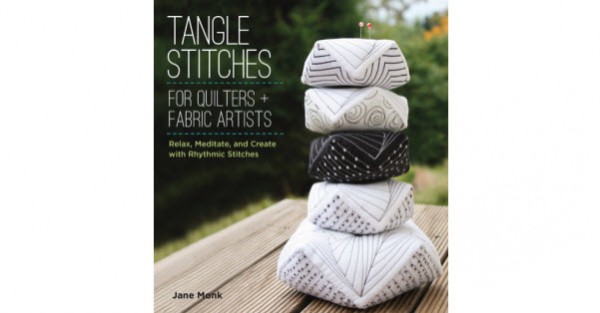
Tangle Stitches Jane Monk

Disclaimer: I was given a copy of this book by the publisher to review. But as always, all opinions expressed here are 100 % my own. 

Review: Step out with Tangle Stitches

Jane Monk is the teacher we all wish we had growing up, in that whatever the challenging subject, she would inspire us to master it. With her new book, Tangle Stitches: For Quilters and Fabric Artists, you’ll feel as if Jane is sitting down with you for a tutoring session on stitching. The premise of her book seems obvious after the fact: she combines Zentangle and needle and thread. Need a way to relax? Hand stitch some Zen. Always been afraid of free motion quilting (FMQ) on a domestic machine? No more with her expert guidance. Afraid to draw? She’s confident you can do it.

In the first part of the book she gives you tools you’ll need, techniques to be successful (such as ways longarm quilters can modify Zentangle for custom work) and patterns for practicing your new skill. The 41 tangle patterns include step outs, these are diagrams for achieving the Zentangle design. The second part of the book includes 10 projects you can stitch using the Zentangle patterns provided in section one. My favorite happens to also be on the front cover, “Pincushion With a Twist”, with instructions on page 71.

Quilters generally fall into 2 categories, those who get more joy from creating the tops and those where stitching is the supreme motivator. With this book, Jane may win the former into the fold of stitching heaven.

Giveaway: Enter to win a copy of this book

The publishers have also given me a book to give away to a lucky Craft Gossip reader. To get a chance to win, leave a comment on this post and tell me the last time you drew something freehand as a creative endeavor and why. It’s okay if it was in grade school.

Contest ends October 4, 2014. Only US and Canadian entrants eligible due to shipping costs.
«
»

Comments

  1. Kylie C says

    September 30, 2014 at 9:12 am

    I actually picked up a Zentangle book from the library about three weeks ago and tried my hand at some little 3″ squares. They were rather soothing and a great size to doodle on with being overwhelmed by all that white space on a sheet of paper. Thank you for a great giveaway.

  2. Lynne Weinberger says

    September 30, 2014 at 9:16 am

    I drew something freehand just before reading about this contest: a Zentangle-decorated envelope for a note I wrote to our son who is moving to a new city and a new chapter in his life.

  3. Kate says

    September 30, 2014 at 10:06 am

    I draw something nearly every day. I’ve tried zentangle and it is calming. I’ve wanted to try it on my quilts, but haven’t yet. This could be the time! Thanks for a chance to win what looks like a very interesting book.

  4. Regina says

    September 30, 2014 at 10:19 am

    Most of my drawing is “thinking on paper” to plan other projects and is usually of the quick and easy “Pictionary” variety where only I know what I have drawn. I am fascinated by Zentangle, though – and want to start.

  5. Cindy says

    September 30, 2014 at 10:32 am

    I love to piece tops, but have always been reserved when it comes to quilting. I’m a stich-in-the-ditch or crosshatch on straight lines person. This subject gives you the opportunity to produce some small free hand quilted projects. I’m definitely going to try this out and see if I can grow to larger projects.

  6. Laurie says

    September 30, 2014 at 10:53 am

    Having always been a stick figure artist, I’m intimidated by drawing and haven’t tried Zentangle yet. I am definitely one who prefers piecing tops but would like to “join the fold of stitching heaven.”

  7. Sharon Buford says

    September 30, 2014 at 11:39 am

    I have been drawing free motion quilting designs. This would be a great book for giving me some additional ideas! Thanks for the review.

  8. Sandy Thomas says

    September 30, 2014 at 11:40 am

    I tried some Zentangle a couple of months ago. I watch videos of it and want to do more. It looks like a great book. I make a lot of baby quilts but never do any free motion quilting on them.

  9. amchart says

    September 30, 2014 at 11:47 am

    I know I’ve drawn things here and there with my kids. They are all better artists than I am!

  10. Nancy Roraback says

    September 30, 2014 at 11:51 am

    Funny, I was just saying to my husband over the weekend that I couldn’t remember the last time I drew. I try to doodle free motion quilting designs whenever I have a chance but I am still learning on my machine.

  11. superstitches says

    September 30, 2014 at 11:59 am

    I usually draw my designs as a freehand sketch first. I do draw frequently. This book looks wonderful.

  12. Mary Mac says

    September 30, 2014 at 11:59 am

    I love to cross stitch and just finished a pumpkin piece that I drew freehand first.

  13. Marilyn says

    September 30, 2014 at 12:14 pm

    Do knitting charts count? I’ve drawn them freehand so to speak. Otherwise it’d be some quilt squares I sketched once upon a time. : )

  14. Barbara Moore says

    September 30, 2014 at 12:20 pm

    I’ve done a little freehand drawing just this past week. I needed to come up with a figure to wood burn. I’ve done a little zentangling and quite a bit of doodling. 🙂

  15. Jennifer Cheek-Payan says

    September 30, 2014 at 12:28 pm

    This book looks fabulous and I’ve been searching for some stitching to do to relax after work. Thank you for the chance to win a copy! The last time I drew was just a few days ago. It was more of a doodle but relaxing none the less.

  16. Shirley says

    September 30, 2014 at 12:29 pm

    I’ve been dabbling in Zentangle for the last year or so, so very mediative. Sketched a face on receipt for waitress yesterday.

  17. Cathy Burgett says

    September 30, 2014 at 1:05 pm

    Does doodling while on hold count as drawing? It can make interesting designs that I have often thought of turning into stitching.

  18. Maxine Miller says

    September 30, 2014 at 1:12 pm

    I draw patterns all the time to use as embroidery patterns for pillowcases or quilt blocks. I love embroidery, it is good for hand exercises and I get something beautiful in the end.

  19. Katrina Ortensie says

    September 30, 2014 at 1:37 pm

    Sadly, I am all pinkies when it comes to drawing. I’ve given up- my stick men have stick heads. But I enjoy quilt tops… I drew lopsided boxes when I planned a quilt from small panels.

  20. Jaan L says

    September 30, 2014 at 1:39 pm

    I drew a funny cat to embroidery on a book bag for my friend’s daughter’s birthday. And I am not an artist in any sense of the word. Would love to win the book. Thanks

  21. Rose Scott says

    September 30, 2014 at 2:06 pm

    My last freehand drawing would have happened yesterday. Not that anyone would want to copy it though. I just love my own work but none of it would be worth publishing.

  22. Toni says

    September 30, 2014 at 2:25 pm

    My freehand drawing probably ended in kindergarten. I fall in to the piecing of quilt tops group. I live several months in a RV so Zentangle sounds interesting and do able with my life style.

  23. Donna H. says

    September 30, 2014 at 3:50 pm

    Its been a long while since I actually drew something completely freehand. Often, I find an image to use as a template, then add my own details freehand as needed.

    I love the idea of this book. Thanks for another great giveaway!!

  24. Theresa says

    September 30, 2014 at 4:36 pm

    The last time I drew free hand was when I was making a pattern for dog and cat placemats. I have seen examples of zentangle but have not tried it myself yet. Thanks for the chance to win the book.

  25. Rose's DIY Crafts, at FineCraftGuild says

    September 30, 2014 at 4:56 pm

    I actually drew something freehand this week, to design a chunky triangle scarf with faux leopard print. It’s really fun. Thank you for the contest!

  26. Michele Timms says

    September 30, 2014 at 5:03 pm

    I probably do more sketching and drawing than I actually realize! I have a journal right beside me and I’m regularly writing ideas, sketching quilt designs, or just doodling. This book would take me in a new direction and I’m always open to new ideas!!

  27. geri actor says

    September 30, 2014 at 5:21 pm

    Last time I did freehand drawing was 30 years ago doing an engineering project

  28. Andrea B says

    September 30, 2014 at 5:30 pm

    last freehand was about a month ago drawing butterflies for my 2 year old niece.

  29. jeanonranch says

    September 30, 2014 at 5:45 pm

    Just finished designing a quilt for some fabulous fabric I collected in Alaska! Books looks so exciting!

  30. Liz Dowdy says

    September 30, 2014 at 6:57 pm

    I have never Zentangled. it would be fun to try something new.

  31. Brenda morris says

    September 30, 2014 at 7:29 pm

    I have a friend who hads done some great work with sent angles and fabric. Now I want to try

  32. Betty says

    September 30, 2014 at 8:58 pm

    I can’t remember when I drew something freehand. . . probably doing art projects with my children about 25 year ago. Too long.

  33. kitblue says

    September 30, 2014 at 9:30 pm

    I’m an Engineer and don’t generally draw freehand. However I took a class on Surveying a couple years ago and had to sketch each layout – in a very small book!

  34. Veronika says

    September 30, 2014 at 9:44 pm

    I like to draw freehand doodles, which I do often (or did before I had kids!) but it’s hard for me to “draw” anything more than that unless I am copying a picture.

  35. Vicki Sprain says

    September 30, 2014 at 9:49 pm

    I teach free motion machine quilting classes and tell my students that one of the best ways to learn a quilting design is to draw it over and over again. I did just that about 6 hours ago today! Thanks for the giveaway! The book looks like one I could really use a lot!

  36. TheGranChris says

    October 1, 2014 at 1:00 am

    My drawing is terrible. I head to coloring books but I try all the time.

  37. Nena says

    October 1, 2014 at 1:54 am

    Haven’t managed to do with pen and paper. Maybe my sewing machine which works better for/with me might be the answer!

  38. lindarumsey says

    October 1, 2014 at 4:53 am

    I can’t honestly remember my last drawing, but my daughter loves art and draws almost daily.

  39. Rosalyn says

    October 1, 2014 at 7:38 am

    I had started zentangles when it first came out and loved. I am thrilled about this book and would so love to win this..I like to make my own patterns and design and know that this will inspire me to learn to do freemotion quilting.

  40. Quilting Tangent says

    October 1, 2014 at 11:53 am

    I draw out and color in my quilt patterns, a few years ago. Takes longer to make the quilt then the pattern.

  41. CAS inOregon says

    October 1, 2014 at 12:16 pm

    I used to draw freehand all the time, I can’t remember the last time I did — other than kisses on my notes to husband.

  42. Kim Jameyson says

    October 1, 2014 at 1:08 pm

    I drew freehand yesterday and almost every day. I always keep a sketchpad at my side especially when we travel. I make free motion “paintings” so I stitch freehand as well as draw. I would love to win this book.

  43. Dennis R Mullins Sr says

    October 1, 2014 at 6:43 pm

    Hi, the last time I drew anything was back in the summer. A friend of mine asked me to draw a quilt square for her, so I designed a quilt block for her. She is making a quilt with squares from several friends. I am very happy she decided to use mine. Thanks for a chance to win.

  44. karen Zumbrun says

    October 1, 2014 at 7:54 pm

    I love zen tangle and I love sewing. My last creative endeavor with a drawing was just yesterday.

  45. Peggy Merk says

    October 2, 2014 at 8:48 am

    I drew some free hand sketches this summer of 2014. I am a teacher and made a wall hanging for my classroom “Coffee Shop.” Coffee cups in the cupboard was a fun Debbie Mum pattern that I will use for my students as we share our book projects each quarter. I decorate the classroom like a real coffee shop with table decorations and pictures hanging throughout the classroom. Students drink hot chocolate and have treats while sharing their books. I am working on creating an additional wall hanging that I drew free hand which will be the “Coffee Shop” sign which features our Coffee Shop. I would love to win a copy of this book! Thanks!

  46. Susan Samuel says

    October 2, 2014 at 3:53 pm

    I’m afraid I do it all the time especially if I am bored.Any piece of paper will do.

  47. Marianne says

    October 2, 2014 at 7:28 pm

    I do it weekly. I’m not very good though It looks like something from grade school.

  48. Susan says

    October 3, 2014 at 2:10 am

    I have tried to draw a quilt layout in the past 6 months, but was not very successful.

  49. ncjeepster says

    October 3, 2014 at 4:15 am

    I am always drawing patterns for machine quilting quilts. I also drawing ideas for fabric designs.
    Thanks for the chance.
    [email protected]

  50. Tina Wong, The Kudzu Sewist says

    October 3, 2014 at 9:13 am

    I’m always doodling…sometimes just in my head. The shower wall is also my doodle pad.

Newer Comments »

Have you read?

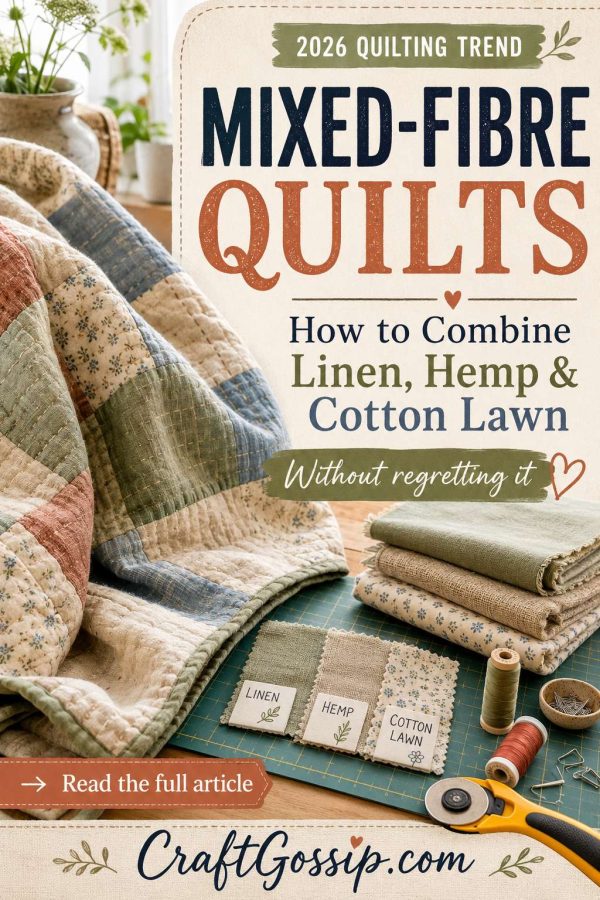
Mixed-Fibre Quilts: How to Combine Linen, Hemp and Cotton Lawn Without Regretting It

For years, beginner quilters have been given one very sensible piece of advice: use quilting cotton.

It is stable, predictable, easy to cut and generally willing to behave itself.

That is still excellent advice for a first quilt. However, once you have made a few quilt tops and stopped feeling personally betrayed by the quarter-inch seam allowance, it can be wonderfully freeing to look beyond standard quilting cotton.

One of the most interesting quilting trends of 2026 is the deliberately mixed-fibre quilt: linen pieced beside cotton lawn, hemp blended with quilting cotton, double gauze used as an accent and textured woven fabrics added for depth.

These quilts are not simply made from whatever fabric happened to be nearby. The most successful examples use differences in weight, weave and texture intentionally.

The result is a quilt that looks softer, feels more tactile and develops even more character with washing and use.

It can also become stretched, puckered and mildly argumentative if the fabrics are not prepared properly, so let us discuss the practical side before cutting into that beautiful piece of linen.

What Is a Mixed-Fibre Quilt?

A mixed-fibre quilt combines fabrics made from different fibres or constructed in noticeably different weights and weaves.

Possible combinations include:

  • quilting cotton and linen
  • cotton lawn and quilting cotton
  • hemp and cotton
  • linen-cotton blends and solid cotton
  • double gauze and quilting cotton
  • cotton chambray and linen
  • reclaimed shirts and new quilting fabric
  • lightweight denim and cotton
  • woven homespun fabric and cotton lawn

The fibres may shrink, stretch and fray differently. That variation is part of the appeal, but it needs to be managed.

If you are still learning fabric terminology, our quilter’s fabric dictionary explains linen blends, voile, double gauze, chambray, quilting cotton and many of the other fabrics you may encounter.

Why Quilters Are Moving Beyond Quilting Cotton

Texture Is Becoming Part of the Design

A printed pattern is not the only way to create visual interest.

Linen has a visible slub. Hemp can have a dry, earthy texture. Cotton lawn is smooth and light. Double gauze is softly crinkled.

Placing these fabrics beside one another creates contrast even when they are the same colour.

A quilt made entirely from cream fabrics can still look richly layered when the weaves reflect light differently.

Natural Fibres Suit the Handmade Aesthetic

Modern interiors are leaning towards relaxed, tactile and less perfectly matched textiles.

Linen, hemp and washed cotton soften with use, wrinkle naturally and create quilts that look comfortable rather than showroom perfect.

This does mean accepting a few wrinkles. Anyone who needs every linen surface to remain crisp may spend more time ironing the quilt than enjoying it.

Mixed-Fibre Quilts Are Excellent for Reclaimed Fabric

Old linen clothing, cotton shirts, lightweight curtains and household textiles can all become part of a quilt.

This makes mixed-fibre quilting useful for memory quilts, scrap projects and low-waste sewing.

Our guide to tiny scrap quilt ideas offers plenty of ways to use small pieces, and many of those ideas adapt beautifully to textured fabric.

The Finished Quilt Feels More Personal

A coordinated fabric collection is convenient and beautiful, but a carefully collected mixture of cloth has a different personality.

The quilt may include new yardage, an old shirt, a scrap of linen from a dressmaking project and one slightly precious piece you have been saving because cutting into it felt too serious.

Mixed-fibre quilting gives those pieces permission to live together.

Understanding the Main Fabrics

Quilting Cotton

Quilting cotton is the useful anchor of a mixed-fibre quilt.

It is tightly woven, stable and available in an enormous range of colours and prints. Use it to support softer or less predictable fabrics.

Fat Quarter Shop and Connecting Threads are helpful sources for solid quilting cotton, background yardage and coordinated bundles. A few stable cottons can calm down a collection of more adventurous fabrics.

Linen

Linen has a beautiful textured weave and becomes softer with washing.

Pure linen can fray heavily and may stretch along loosely woven edges. Linen-cotton blends are often easier for quilting because they retain the texture of linen while behaving more like cotton.

Use linen for:

  • large squares and rectangles
  • wide borders
  • simple appliqué
  • wholecloth sections
  • low-volume backgrounds
  • large-scale modern blocks

Avoid making your first linen quilt from hundreds of tiny pieces. Life is already complicated enough.

Hemp

Hemp fabric is strong, breathable and often has a slightly rustic texture.

Depending on the weave, it may feel similar to linen or canvas. Lightweight hemp and hemp-cotton blends are usually more suitable for quilt tops than heavy upholstery-weight hemp.

Use it for larger pieces, borders and strong geometric sections.

Cotton Lawn

Cotton lawn is finely woven, lightweight and smooth.

It can add softness and delicate printed detail to a quilt, but it may shift or distort during cutting and sewing.

Spray starch, careful pressing and a fine sharp needle can make it easier to handle.

Cotton lawn works particularly well in:

  • hand-quilted summer quilts
  • lightweight baby quilts
  • soft appliqué
  • large patchwork pieces
  • quilt backs
  • low-volume mixed backgrounds

Double Gauze

Double gauze is made from two lightweight layers joined at regular points.

It is wonderfully soft but can stretch, fray and distort. Use larger blocks, avoid excessive handling and consider stabilising it before cutting.

Chambray and Lightweight Denim

Chambray gives the look of denim without quite as much weight.

Lightweight denim can also be used, but pay attention to bulky seam intersections. Combine it with stronger cotton or linen rather than very delicate lawn in tiny piecing.

Prewash or Do Not Prewash?

Mixed-fibre quilting is one situation where prewashing is usually the safer choice.

Different fibres can shrink at different rates. Linen may soften and contract, cotton lawn may wrinkle and hemp may change substantially after its first wash.

Prewashing allows each fabric to complete much of that initial movement before it becomes permanently joined to the others.

Wash the fabrics using the same method you expect to use for the finished quilt.

Then:

  1. Dry them completely.
  2. Press them flat without stretching.
  3. Square the grain where possible.
  4. Test any fabric that still feels unstable.

There is one exception.

Some quilters deliberately leave all fabrics unwashed because they want the crinkled texture created by uneven shrinkage. That can be a valid design choice, but it is less predictable.

Do it because you want the effect, not because the laundry basket was full.

Test the Fabrics Before Cutting

Create a small test sandwich using scraps of every fabric you plan to combine.

Piece them together, add batting and backing, then quilt and wash the sample.

Check for:

  • excessive shrinkage
  • colour bleeding
  • seam distortion
  • fraying
  • different rates of stretching
  • stiffness
  • unexpected transparency
  • puckering around quilted lines

A twenty-centimetre sample can save an entire quilt top.

It also gives you an excuse to make a matching coaster, which is what we call turning responsible preparation into a finished project.

Match Fabric Weights Carefully

Mixed-fibre does not have to mean wildly mismatched.

The safest combination is a group of fabrics with different fibres but reasonably similar weights.

For example:

  • medium-weight linen with quilting cotton
  • linen-cotton blend with chambray
  • lightweight hemp with cotton
  • cotton lawn with voile and lightweight quilting cotton

A very heavy fabric placed beside a very fine one can pull the lighter fabric out of shape.

When you do want dramatic weight contrast, use the heavier fabric in larger isolated sections rather than alternating it through tiny blocks.

Stabilising Lightweight Fabric

Cotton lawn, voile, double gauze and loose linen may benefit from temporary or permanent stabilisation.

Options include:

Spray Starch

Starch adds temporary body and makes fine fabric easier to cut accurately.

Apply it before cutting and press rather than pushing the iron back and forth.

Lightweight Woven Interfacing

A very lightweight woven interfacing can support unstable fabric without making it feel like cardboard.

Test it first, particularly if the quilt needs to remain soft and drapey.

Foundation Piecing

Sew lightweight fabric onto a thin cotton or muslin foundation.

This is useful for improvisational blocks, strings and areas made from irregular scraps.

The foundation controls stretching and gives mixed materials a more consistent base.

Choose Forgiving Quilt Blocks

Simple blocks are usually the best showcase for mixed fibres.

Good options include:

  • large nine-patch blocks
  • oversized half-square triangles
  • log cabin blocks
  • simple strip quilts
  • checkerboard layouts
  • large crosses
  • broad courthouse steps
  • improvisational panels
  • framed rectangles
  • wholecloth sections mixed with pieced blocks

Our roundup of easy quilt layouts for beginners contains several structures that work well when the fabric texture is intended to be the main attraction.

Large pieces allow linen, hemp and lawn to drape naturally.

Tiny precision piecing can still be done, but it requires more stabilisation, more pinning and considerably more conversations with the seam ripper.

Cutting Mixed Fibres Accurately

Use a fresh rotary blade.

Loosely woven fabrics can drag under a dull blade, creating ragged or distorted edges.

A large cutting mat, non-slip ruler and sharp rotary cutter make a noticeable difference. AccuQuilt fabric cutters can also be useful for repeatedly cutting stable linen blends, cottons and lightweight woven fabrics into consistent shapes.

Before cutting:

  • press the fabric
  • identify the grain
  • apply starch if needed
  • avoid allowing fabric to hang off the table
  • cut one layer at a time when accuracy matters
  • handle bias edges gently

Do not pull an awkward linen corner into alignment and hope the seam will sort it out. The seam remembers.

Sewing Mixed-Fibre Quilt Blocks

Use a consistent quarter-inch seam allowance, but adjust your approach for each fabric.

Reduce Handling

Repeatedly lifting, folding and rearranging loose fabric can stretch the edges.

Lay out the blocks before sewing and handle them gently.

Use More Pins

Stable quilting cotton often behaves with minimal pinning. Linen and lawn may need additional help.

Pin at the beginning, end and along the seam, particularly when two fabrics have different levels of stretch.

Sew with the More Stable Fabric Underneath

The feed dogs can help move the lower layer evenly.

Placing the more stable fabric underneath may reduce shifting, although testing is always worthwhile.

Shorten the Stitch Length Slightly

A slightly shorter stitch can improve seam security in fabrics that fray.

Do not make the stitch excessively tiny, as that can weaken delicate fabric or make mistakes miserable to unpick.

Press Rather Than Stretch

Lift and lower the iron rather than pushing it aggressively across the seam.

Use a pressing cloth for delicate surfaces and check whether the fabric tolerates steam.

Finishing Raw Edges

Quilt blocks are usually protected inside the finished quilt, but heavily fraying fabrics may continue to unravel during construction.

To control fraying:

  • use a shorter stitch length
  • increase the seam allowance if the pattern permits
  • stay-stitch around completed blocks
  • use a lightweight foundation
  • handle cut pieces as little as possible
  • quilt the finished top reasonably closely

A serged edge is rarely necessary for every quilt seam and may add too much bulk.

Choosing Batting

The batting should complement the combined weight and intended use of the quilt.

Cotton Batting

Cotton provides stability and creates a soft, traditional drape.

It is a dependable choice for linen and cotton quilts.

Wool Batting

Wool is lightweight, warm and easy to hand quilt.

It can emphasise texture without making the quilt excessively heavy.

Bamboo or Bamboo Blends

Bamboo-blend batting can create a soft, fluid quilt suitable for lighter fabrics such as cotton lawn.

Polyester Batting

Polyester adds loft and dries quickly, although it may feel less natural beside linen and hemp.

Always check the recommended quilting distance. The right batting is not simply filler; it affects the drape, warmth and final texture of the quilt.

Quilting the Layers

Simple quilting often works best because mixed fibres already provide visual interest.

Try:

  • widely spaced straight lines
  • gentle wavy lines
  • large hand-quilted grids
  • echo quilting
  • chunky running stitches
  • simple crosshatching
  • quilting within individual fabric sections

Visible hand quilting is particularly beautiful across linen and hemp.

A thicker thread creates small shadows and emphasises the handmade quality of the cloth. Check our guide to quilting needles for piecing and hand quilting before forcing thick thread through a tiny needle and blaming both of them.

Avoid extremely dense quilting if the aim is a soft, relaxed bed quilt. Close quilting can flatten the textures and make the finished quilt feel stiff.

Binding a Mixed-Fibre Quilt

Stable quilting cotton is usually the easiest binding choice.

The outer edge of a mixed-fibre quilt receives plenty of wear, and a firmly woven cotton binding can support more delicate fabrics within the quilt top.

Linen binding is beautiful but may fray. Use a linen-cotton blend, cut generous strips and avoid an overly narrow finished binding.

Our guide to binding a quilt with neat corners walks through a reliable finishing method.

Three Easy Mixed-Fibre Quilt Palettes

Soft Neutral Quilt

Combine:

  • natural linen
  • cream quilting cotton
  • pale grey cotton lawn
  • oatmeal hemp blend
  • low-volume printed cotton

Use a large checkerboard or broad strip layout and finish with chunky cream hand quilting.

Reclaimed Blue Quilt

Combine:

  • chambray shirts
  • lightweight denim
  • blue linen
  • striped cotton
  • indigo quilting cotton

Use large log cabin blocks or improvisational rectangles.

Gentle Floral Quilt

Combine:

  • floral cotton lawn
  • solid linen-cotton blend
  • soft quilting cotton
  • pale double gauze
  • one darker cotton for contrast

Use oversized nine-patch blocks to keep the fine fabrics stable and visible.

Mixed-Fibre Quilting Is About Experimenting Thoughtfully

There is a difference between an intentionally mixed-fibre quilt and sewing every fabric in the scrap basket together while hoping for the best.

The intentional version considers weight, shrinkage, stretch, weave and how the finished quilt should feel.

Begin with fabrics that are reasonably compatible. Prewash them, make a sample and choose a simple design that allows the textures to shine.

Once you understand how the cloth behaves, you can become more adventurous.

That might mean combining fine lawn with sturdy hemp, adding a section of reclaimed clothing or allowing one loosely woven linen to wrinkle more than its neighbours.

Those variations are not necessarily flaws. They are part of what makes the quilt tactile, relaxed and personal.

Quilting cotton will always have a well-earned place in the sewing room. But it does not have to be the only fabric invited to the quilt.

Categories

Christmas quilts Craft Competitions Craft News and Events Free Quilt Patterns Modern More Quilting Patterns & Projects Quilting Art Quilts Quilting Blocks Quilting Books Quilting Contest Quilting Events Quilting Fabric Quilting Gift Ideas Quilting How To & Tutorials Quilting Inspiration Quilting Products Quilting Technique Scrap Fabric Tutorials and Patterns

RSS More Articles

  • Sweet Apple Cross Stitch Patterns
  • How To Make A Stretch Bead Bracelet For Beginners
  • DIY Emotional Support Chicken Plush Pattern
  • Beautiful Brazilian Embroidery Flowers to Try
  • Vintage Knitted Coat Pattern PDF – Pembroke Coat
  • How to Tell the Difference Between Dry Scalp, Dandruff and Product Buildup
  • 12 Handmade Card Ideas with Summer and Tropical Drinks
  • 10 Fall Leaves Scrapbook Layout Templates for Cosy Autumn Memory Keeping
  • Activities and Crafts for Johnny Appleseed Day
  • Totoro Knitting Patterns

Copyright © 2026 · CraftGossip | Start Here | Contact Us | Link to Us | Your Editors | Privacy and affiliate policy