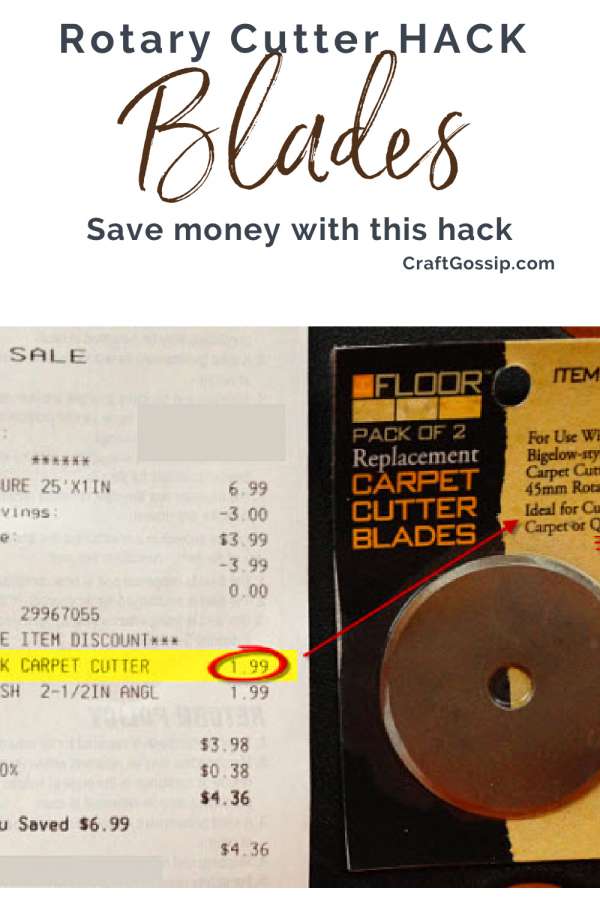
After buying this carpet cutter at my local Harbor Freight, I feel like Lee in that Swiffer commercial who exclaimed, “I’ve been living in a fool’s paradise.” Notice the product description says, “Ideal for Cutting Carpets or Quilts“. Right now, if you visit Jo-Ann Fabrics online, they are selling 1 blade for $17.99. Yes, it’s the top brand, an Olfa
 , but is the ‘better quality’ enough to justify the difference in price? I plan to find out. I’ll use these in my next project and let you know. If you have already used a carpet cutter
 to cut fabric, do share your thoughts with us. {Image uploaded by editor}
Are you looking for a way to make quilting and sewing projects easier? If so, a rotary cutter is the perfect tool for the job. A rotary cutter is a handheld tool used to quickly and easily cut through fabric, making it the perfect tool for quilting and sewing projects.
Rotary cutters are incredibly easy to use and provide a much more precise cut than scissors. Rotary cutters come in a variety of sizes and shapes, so you can find the perfect one for your project. They have a sharp blade that quickly and easily cuts through fabric, making it faster and easier than using scissors. The ergonomic handle makes it comfortable to hold and use, so you can get the job done quickly and easily.
Rotary cutters are also incredibly versatile. They can be used on a variety of materials, including cotton, flannel, fleece, and more. This makes them perfect for a variety of projects, from quilts to apparel. And because they are so easy to use, they are great for beginners and experienced sewers alike.
If you’re looking for a way to make quilting and sewing projects easier, then a rotary cutter is the perfect tool for the job. With its sharp blade and ergonomic handle, it makes it faster and easier to get the job done. And because it can be used on a variety of materials, it is perfect for any quilting and sewing projects. So, if you’re looking for a way to make your projects easier and more efficient, then a rotary cutter is the perfect tool for the job.
My question is how did you get 100% off the tape measure you bought above the rotary cutter????
It was on special Trish!
I also find that sewing machine oil is also expensive for no reason. I know there’s a cheap replacement and I can’t remember at this moment what it’s called.
Good tip Venus, thanks. I’ll start looking elsewhere. –Scarlett
Do they fit the olfa or fiskers cutter?
I have been using these for a few years now and love them. I buy three or four every time I go into Harbor Freight. After spending tons of money on “good” rotary blades I found theses. They only come in 45 mm size but that is fine with me. I find that I do change them a little more often, however for a buck a piece it’s well worth changing them. They also sharpen up to a pretty good edge.
Good question Therese. As far as I know, if you get the right size, you can use a straight rotary cutter blade in any brand of Rotary Cutter. This one is a 45mm, that’s the size I use. I didn’t see any larger/60mm at Harbor Freight.
The oil is just plain ol 3-N-1 oil at ant hardware !
Thanks for sharing Bernie! Now, I cannot wait to try them. –Scarlett
Really Vickie? Oh my, I am learning some things tonight. Thanks so much for sharing this with us. –Scarlett
I use them and have had no problems at all with them. I recently bought an electric blade sharpener too, so I’m going to try and stretch my blade money even further.
I can’t remember the item, but it was packaged in brown on the notions aisle, and the exact same thing by the same company was packaged in blue on the upholstery aisle for about $2 less. I asked the employee to tell me what the difference, was and she agreed it was the exact same thing.
I’ve seen it on all kinds of products. Just have to think outside the box. 🙂
Great find! Another thing I have bought at Harbor Freight that is way overpriced elsewhere was their pick set – it was $3.99 for 5 tools that I use for ‘weeding’ vinyl and cardstock cut on my Cricut and Silhouette cutting machines. The Cricut brand set of tools is about $25.
Harbor freight has all sort of coupons in the Sunday paper and in those inserts like Valpak also they were on the back of Parade Magazine in the paper last Sunday. Tape measures, led lights, a grabber, and screwdrivers are usually really cheap or free with the coupon and purchase.
Thank you so much for sharing these blades! I can’t believe the savings.
Thanks so much for sharing. I will have some by the end of the week.
OMG – yet another thing where manufacturers overcharge women for the same products! I am going to Harbor Freight tomorrow! Thanks for sharing this!
That’s not the only thing. I went in to a fabric shop and saw a set square, price $70. Went to the hardware store…. $20. Cord and chains should also be bought at the hardware store.
Well, now my husband will be happy to know that he has one more reason to go to harbor freight! 🙂
I use cheap blades in my olfa and never have a problem
I haven’t used the blades from the hardware store myself, but I have seen MANY reviews online and they are always so mixed. Half the people say they’re great, sometimes dull faster. The other half say they’re awful, skip a lot, catch on the fabric, and once in a blue moon somebody will have fit issues.
I have bought them and the difference for me is the brand blade is notched in the middle. The cutters I have don’t rotate well without the notched blade. The oil issue is something that you should buy sewing machine oil because it is different then 3-n-1 oil. I worked for a sewing machine company and the repairs that came in where they had used 3-n-1 oil had a sticky mess to clean up. So buyer beware.
Tri-Flo is a good oil to use also.
I’ve used them and the Marteli blades that go with their cutters. They also have tips on how to make your blades last YEARS. I see no difference. One thing you need to pay attention to with HF blades. Make sure you separate them They stick together and two blades in your cutter make your cutting life miserable. Ask me, I know.
I tried them and still prefer the real deal. I found they just didn’t last any time. Someday when I’m out of money though, I’ll go back to them!
I have been using them for a while now and have no problem with the blades from harbor freight
i have been using the harbor freight blades since the store opened here on long island. and i think they work just fine. i have not had any issues with the blades cutting or snagging. but then when the blade gets dull i change the blade quickly. i dont use the blade til it wont cut. for 1.99, they work just fine for me.
I guess I got unlucky. The 2 packs I bought were both useless. I was so excited to try this awhile back and it was terrible. The edges weren’t even and left a wobbly mess of my fabric. Some weren’t smooth and kept catching and pulling my fabric. After that I just went back to my usual expense ugh. Glad it works for some 🙂
3n1 oil is not for sewing machines it will gum them up. I use only sewing machine oil for my machines.
I haven’t had good luck with them. About 4 years ago I bought my first ones and they worked fine. The last 6-8 packages I have thrown away immediately as they skipped.
I have used the Harbor Freight carpet blades for 2 years and buy them every time we go in (so I have a stash!). I also bought the mechanics nut and bolt holder (its magnetic) to use for errant pins by the machine. Couldn’t ask for better-some of the blades you have to toss ( unless you have a sharpener); but over all I have had the best luck with Harbor Freight items
There are so many “tools” one can get for a whole lot cheaper at a hardware, big box or discount store if one is willing to look around and be patient.
One can also go to the big box stores get plexiglass cut to a specific size then come home and use tape (or whatever) to make grid lines on the plexiglass to replace the expensive rulers.
On the subject of buying from Harbor Freight, check out their 4” or 6” magnetic mechanic’s dish. Makes the best pin catcher. The magnet is incredible! It sticks to my ironing board. I use it to pick up dropped pins. The magnetic field grabs the pins as you drop them in the dish.
One of our quilt guild ladies buys out HF every time she goes there for the blades so the rest of us have to coordinate between her visits – LOL – but she does share. In all these years we have had some that skip or just don’t cut as well, but for a quilt guild, it’s worth it for the amount of cutting we do.
Also – go to Home Depot and buy the thick plexi-glass plastic – they’ll cut it to the size you need so if you just want to square everything down to a constant 9 1/2, 12 1/2, 6 1/2, etc., that’s a GREAT way to get an inexpensive and long-lasting ruler!
I even go to our local plastic place-here it is called Tap Plastic-I have had them make me long rulers and pieces for templates and for my long arm-the are wonderful about cutting what you need for your projects! And at about a quarter of the price, I can afford more specialty things!!!!
I buy Fisker package of 5 for $16.17 through a Wal-Mart on line. That’s 3.23 per blade…no problems with them. But a friend recommended that Harbor Freight carried the blades for a lot less.
I make samples for a store and therefore do a lot of cutting. I tried these and DO NOT recommend them! I tried them in all my cutters: Fiskar, Olfa & Fons & Porter. Didn’t rotate evenly, Did not cut smoothly. Actually did a bit of damage to my self-healing mat. Although the ‘real thing’ is more expensive, when buying on sale and with coupons, it is very much worth it.
Nothing to add, but I LOVE all the great ideas here!!!
These blades are hit and miss. Some are sharp but most I have tried are dull. It was too frustrating changing out blades to find a good one. A good sharp blade is worth the price. Have you priced quality circular saw blades your DH is buying? He laughed when I was complaing about the cost of a rotary blade.
What a great idea Carolyn. Thanks for sharing with us. –Scarlett
Thanks Quiltmouse for sharing your experience with us. –Scarlett
Wow, another great idea here. Thanks for sharing. –Scarlett
Just glad you visited Knitbunnie! –Scarlett
Harbor freight blades were a big rip off. I don’t know how people get them to work for them, but I tried 4 different blades and none of them cut a clean cut. Took twice as long and edges were ched up.
My experience is that they are okay–but not as good as the “name brand” ones like Olfa and Fiskars. I’ve tried both and I’m not particularly brand loyal, but I don’t believe that they are “the same”.
I have used them for several years. Have had maybe 3 that didn’t work well after cutting for a few hours. Just tossed it, started ith a new blade. $1 each is a lot easier to toss out than $5 or $8 each, I use those til I should have tossed it many many cuts ago! I use the magnetic bolt (PIN) catchers at ever station, ironing board, serger, etc. I have a 6′ metal heavy ruler, several sets of inexpensive screwdriver sets (so I can have them at each station as well). If you walk around with an open mind, you can fill the needs you have for the sewing studio right there in the hardware department! By the way, several clerks have told friends that we don’t have rotary blades….they don’t know! In the carpet tool aisle! I even bought the tool once in a pinch, It came with 2 blades and was 2.99.
Oh my gosh I’m excited!!!! I never saw these or I would have bought them. I’m going tomorrow and buy a few.
Harbor Freight also sells suction cup holders for glass that work quite well for holding your rulers on fabric when cutting. I’ve had mine for many years so the purchase price of 3.99 is probably out of date. They also sell the single suction cup holder that works great with 6, 9 10 and 12″ square templates.
I have been using HF blades for several years. I do sharpen mine and after one – two months of cutting, I replace the blade. Works well for me. I have only had one blade in several years not do well and I just tossed it.
I’ve been using Harbor Freight blades for 2 years. I find they do a great job and last a long while. For the price, you can’t go wrong.
I’ve had no luck with Harbor Freight’s blades. but I do find lots of other neat things there. Also you can usually get a good buy on 5 or 10 blades through Hancock’s of Paducah.