• Home
  • Suggest A DIY
  • DIY Newsletter

Quilting

Patterns, patchworks and projects

  • About CraftGossip
  • Our Network
    • Bath & Body Crafts
    • Candle Making Ideas
    • Crochet Ideas
    • Cross Stitch
    • Edible Crafts
    • Felting Patterns
    • Glass Art
    • Home & Garden Ideas
    • Indie Crafts
    • Jewelry Making
    • Kids Crafts
    • Knitting Patterns
    • Lesson Plans
    • Needlework
    • Party Ideas
    • Polymer Clay
    • Quilting Ideas
    • Recycled Crafts
    • Scrapbooking
    • Sewing Patterns
    • Card Making
    • DIY Weddings
    • Not Craft Ideas
  • Giveaways
  • Roundups
  • Store
  • Search

Rotary cutter blades a rip off?

September 15, 2014 by Scarlett Burroughs

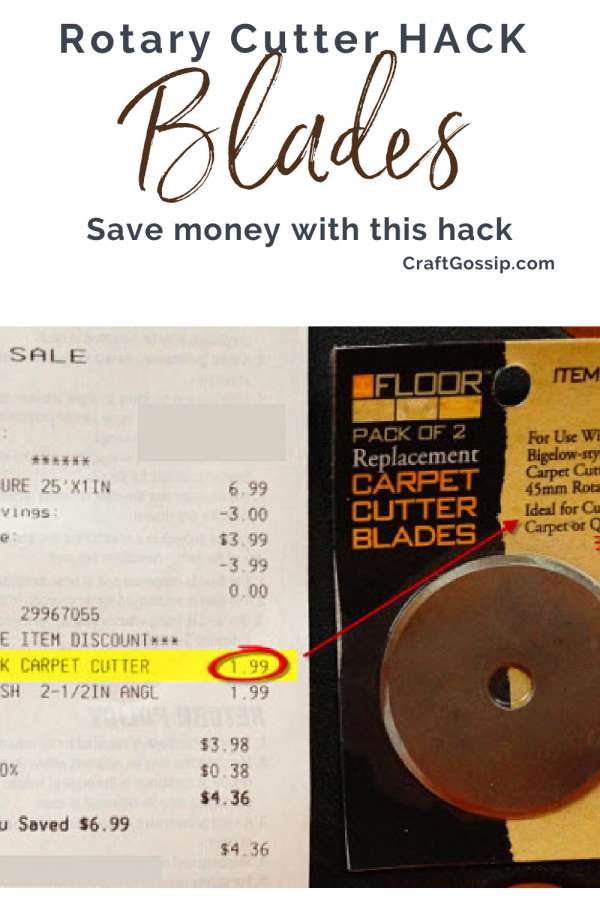
After buying this carpet cutter at my local Harbor Freight, I feel like Lee in that Swiffer commercial who exclaimed, “I’ve been living in a fool’s paradise.” Notice the product description says, “Ideal for Cutting Carpets or Quilts“. Right now, if you visit Jo-Ann Fabrics online, they are selling 1 blade for $17.99.  Yes, it’s the top brand, an Olfa, but is the ‘better quality’ enough to justify the difference in price? I plan to find out. I’ll use these in my next project and let you know. If you have already used a carpet cutter to cut fabric, do share your thoughts with us. {Image uploaded by editor}

Are you looking for a way to make quilting and sewing projects easier? If so, a rotary cutter is the perfect tool for the job. A rotary cutter is a handheld tool used to quickly and easily cut through fabric, making it the perfect tool for quilting and sewing projects.

Rotary cutters are incredibly easy to use and provide a much more precise cut than scissors. Rotary cutters come in a variety of sizes and shapes, so you can find the perfect one for your project. They have a sharp blade that quickly and easily cuts through fabric, making it faster and easier than using scissors. The ergonomic handle makes it comfortable to hold and use, so you can get the job done quickly and easily.

Rotary cutters are also incredibly versatile. They can be used on a variety of materials, including cotton, flannel, fleece, and more. This makes them perfect for a variety of projects, from quilts to apparel. And because they are so easy to use, they are great for beginners and experienced sewers alike.

If you’re looking for a way to make quilting and sewing projects easier, then a rotary cutter is the perfect tool for the job. With its sharp blade and ergonomic handle, it makes it faster and easier to get the job done. And because it can be used on a variety of materials, it is perfect for any quilting and sewing projects. So, if you’re looking for a way to make your projects easier and more efficient, then a rotary cutter is the perfect tool for the job.
 

«
»

Comments

  1. Pat says

    September 16, 2014 at 4:05 pm

    I tried them and didn’t like them, they skipped. I never buy blades from Joann’s, too expensive. Have gotten great deals on ebay.

  2. Cindy F. says

    September 16, 2014 at 4:07 pm

    I tried these, but found they were too dull right out of the package, so didn’t work well. Went back to the expensive ones.

  3. Ellen Gregory says

    September 16, 2014 at 4:15 pm

    Yasmin, I am a novice so forgive the question, please. What is a set square that you get at the hardware store for $20, and what are the cord and chains for? Loved all of the other suggestions, especially about HF, but I was puzzled on this one. Thanks.

  4. Tammy Mattson says

    September 16, 2014 at 4:20 pm

    I won’t use any oil on my sewing machine except for Tri Flo. all the others including “good sewing machine oils” I.e. expensive, gum up the sewing machine after a period of time. Ask me how I know! It cost me $120 to de-gum my Vintage Husqvarna Viking sewing machine that prior owners had used regular sewing machine oil on over the years. Tri-Flo won’t do that.

  5. Pat Rand says

    September 16, 2014 at 6:19 pm

    Just wanted to say ,ask your dental person that cleans your teeth if she has any dental picks she doesn’t use anymore.I did and came home with about 16 for free.Shared with friends

  6. Gladys Dodger says

    September 16, 2014 at 9:44 pm

    I have been using carpet cutter blades I buy at Harbor Freight for several years. I have never been disappointed with them. I gave some to my sister and now everyone in her 3 quilt groups are using them too.

  7. Susan F. says

    September 16, 2014 at 10:23 pm

    I have used these with good results most of the time. I got one package that wouldn’t cut butter though.

  8. nancy d says

    September 16, 2014 at 10:52 pm

    Excellent tip! I find myself using dull blades as I hate spending so much money on them! Harbor Freight normally has coupons for a free item with a purchase too! I love that place!

  9. Scarlett Burroughs says

    September 17, 2014 at 6:33 am

    Thanks for sharing Tammy. I’ve not heard about Tri Flo until now! –Scarlett

  10. Scarlett Burroughs says

    September 17, 2014 at 6:35 am

    Great suggestion Carol! Thanks for sharing. –Scarlett

  11. Scarlett Burroughs says

    September 17, 2014 at 6:36 am

    Awesome information Linda. Thank you! –Scarlett

  12. Mary G. says

    September 17, 2014 at 2:51 pm

    I have been using these carpet blades for a couple years now and have only come up with one blade that was a dud. Very happy with them and the money I save at Harbor. You need to remember too when you are looking at cutters and blades – some cutters have special cut outs or designs in the center that requires that you can only use their blade.

  13. Scarlett Burroughs says

    September 17, 2014 at 2:55 pm

    Thanks for sharing Mary! –Scarlett

  14. ruthee says

    September 18, 2014 at 10:39 am

    Wish we had a Harbor Freight…

  15. Yvonne says

    September 19, 2014 at 8:56 am

    I use them all the time. Every once in a while I get one not so sharp but that’s rare. And you get two in a package, not one!

  16. Lauren says

    October 1, 2014 at 1:25 am

    I have tried these, and I have been completely unsatisfied. I bought 3 packs because they were so cheap, and I was so excited to save a bit on blades. The first blade skipped, and I thought it might just be a dud, but hey that’s why I bought a coupe other packs and they’re cheap so no big deal. Guess what? The other blades all skipped too. You get what you pay for here. I keep buying mine from the local quilt shop…better to support the local shop and pay a little more than to go to the big box store and get duds.

  17. Scarlett Burroughs says

    October 1, 2014 at 9:35 am

    I hear you Lauren. I still have not tried the cheap blades, but have lowered my expectations. –Scarlett

  18. Cynthia Prater says

    October 1, 2014 at 5:04 pm

    I discovered these early on in my quilting adventure and I like them. Yes every now and again I get a bad blade, but for the price, why not. I then use the dull ones for paper piecing. It got so bad that my local harbor freight stop carrying in the store. Nothing wrong with trying an off brand and lower price item. We all are different and like what we like. I will tell any quilter try something and if it don’t work at least you tried and you can’t turn your nose up at it. Especially with the blades costing so much and still going dull. Here is a post I did on them years ago http://allaboutmeandcrafts.blogspot.com/2011/01/central-forge-carpet-cutter-blades.html

  19. Janet Kelley says

    January 16, 2022 at 8:34 am

    I use a Rotary blade sharpener and it works really well.

  20. catpatches says

    January 16, 2022 at 10:00 am

    I tried the carpet cutter blades once. Not for me.

« Older Comments

Have you read?

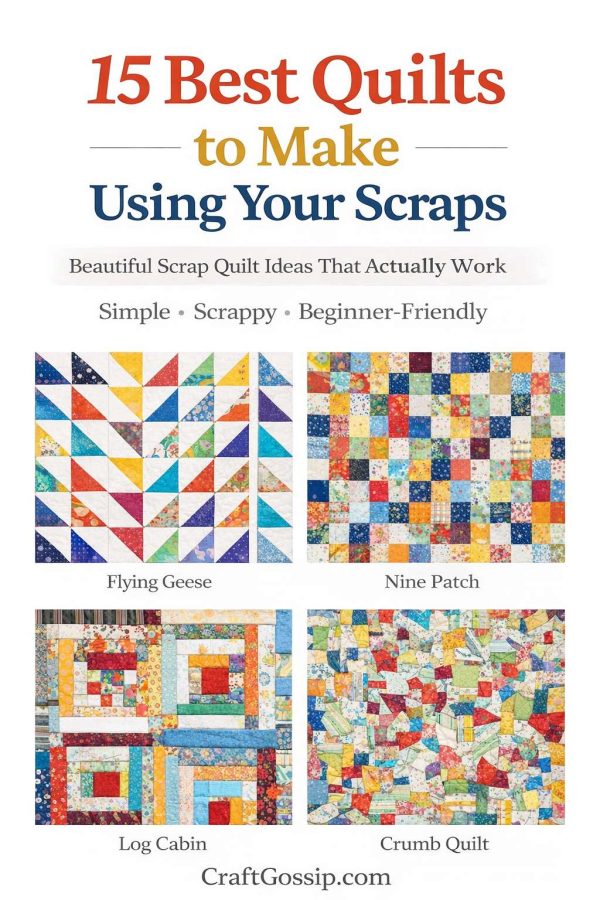
15 Best Quilts to Make Using Your Scraps (Beautiful Scrap Quilt Ideas That Actually Work)

If you’ve ever stood in your sewing room staring at a basket of fabric scraps thinking, “I should do something with these,” this article is for you.

Scrap quilts aren’t just practical — they’re often the most joyful quilts we make. They’re forgiving, colorful, and deeply personal. Every leftover piece carries a memory from a past project.

If you’re searching for the best quilts to make using your scraps, this guide goes beyond inspiration. We’ll talk about which patterns truly work for scraps, how to keep them looking cohesive, how much fabric you actually need, and which scrap sizes suit which designs.

Let’s turn that scrap pile into something intentional.

Why Scrap Quilts Are So Popular (And Why They Work)

Scrap quilts continue to trend because they:

  • Reduce fabric waste
    • Use leftovers from past projects
    • Feel nostalgic and personal
    • Save money
    • Encourage creativity without pressure

Unlike tightly planned quilts, scrap quilts allow flexibility. Slight variations in tone, scale, and print aren’t flaws — they’re part of the charm.

And for many of us, they’re emotionally satisfying. That tiny floral from a baby quilt? It shows up again in a new design.

What Makes a Quilt Pattern Truly Scrap-Friendly?

Not every quilt pattern works well with mixed fabrics.

The best scrap quilt patterns share these traits:

  • Repeated simple blocks
    • Uniform block size
    • No reliance on large focal prints
    • Strong layout grid
    • Balance of light and dark values

The structure holds the design together while the scraps bring personality.

If a pattern depends on exact color placement or large uninterrupted shapes, it’s usually not ideal for scraps.

1. Half Square Triangle Scrap Quilt

This is the ultimate scrap quilt.

Half square triangles (HSTs) use small squares and create endless layout possibilities.

Why it works beautifully for scraps:

  • Uses small pieces efficiently
    • Easy to chain piece
    • Allows strong contrast
    • Works with controlled or random color placement

You can create:

  • Chevron layouts
    • Diamonds
    • Broken dishes
    • Pinwheels
    • Modern gradient quilts

If you’re unsure what to do with your scraps, start here.

2. Crumb Quilt (Tiny Scraps Welcome)

If your scraps are small and irregular, crumb quilting is magic.

Instead of cutting into precise shapes, you sew scraps together randomly into larger “slabs,” then trim into blocks.

Why crumb quilts shine:

  • Uses the smallest pieces
    • No strict measuring
    • Highly forgiving
    • Great for improv lovers

Crumb quilts look chaotic mid-process — but once assembled, they’re surprisingly cohesive.

3. String Quilt

String quilts use narrow strips sewn onto a foundation.

Perfect for:

  • Long skinny leftovers
    • Binding offcuts
    • Strips trimmed from squaring blocks

You can sew strips diagonally, vertically, or randomly. When blocks are squared up, the quilt looks deliberate.

String quilts are fantastic for beginners because seam accuracy is less stressful.

4. Log Cabin Scrap Quilt

A true classic.

Log cabin blocks use strips built around a center square.

Why it works for scraps:

  • Uses varying strip lengths
    • Creates strong light/dark contrast
    • Looks intentional even when scrappy

Keep your center squares consistent for visual balance.

5. Nine Patch Scrap Quilt

Simple.
Reliable.
Endlessly adaptable.

Nine patch blocks use small squares — perfect for 2½” or 3½” scrap cuts.

Why it works:

  • Quick to assemble
    • Easy chain piecing
    • Beginner-friendly

Alternate with solid blocks or add sashing for structure.

6. Flying Geese Scrap Quilt

If you have medium-sized scraps, flying geese blocks are ideal.

Scrappy geese with a consistent background fabric prevent visual overload.

They create strong directional movement across a quilt top.

7. Irish Chain Scrap Quilt

This block balances structure with randomness.

Scrappy chain units combined with solid blocks create breathing space.

It’s a beautiful option if you want scrap charm without chaos.

8. Checkerboard Scrap Quilt

Sometimes the simplest layouts are the most powerful.

Equal-sized squares in alternating placement create a bold grid.

This design works best when you pay attention to light vs dark balance.

9. Sawtooth Star Scrap Quilt

Scrappy star points paired with solid backgrounds create stunning contrast.

You can keep star centers consistent for cohesion.

It feels classic but works beautifully in modern color palettes.

10. Rail Fence Scrap Quilt

Strip-based and fast to assemble.

Rotate blocks to create zigzags or woven effects.

This quilt is ideal for 2½” strip scraps.

11. Postage Stamp Quilt

If you love tiny pieces, this is your project.

Small squares sewn into a dense grid create a pixelated effect.

Time-consuming — but breathtaking.

12. Broken Dishes Quilt

Made entirely from half square triangles.

It creates a shattered-glass pattern that looks far more complex than it is.

High-contrast scraps work best here.

13. Pineapple Scrap Quilt

For confident quilters.

This design uses small strips in layered rotation around a center.

It’s intricate and dramatic — perfect for organized scrap bins.

14. Modern Negative Space Scrap Quilt

Use scrap blocks surrounded by solid white or low-volume background.

The empty space allows the scrap sections to shine without overwhelming the eye.

15. Sampler Scrap Quilt

Combine multiple scrap-friendly blocks into one quilt.

It keeps things interesting and prevents fabric fatigue.

Perfect if you enjoy variety.

How to Keep Scrap Quilts From Looking Too Busy

This is where many scrap quilts struggle.

Here’s how to maintain cohesion:

  • Use a consistent background fabric
    • Limit to 2–3 color families
    • Balance warm and cool tones
    • Keep block size uniform
    • Add sashing if needed

Even the wildest scrap quilt benefits from repetition.

Sorting Your Scraps Before You Start

Instead of dumping everything into one pile, try sorting by:

  • Light / medium / dark
    • Color family
    • Strip vs square vs crumb
    • Tone (warm vs cool)

This makes choosing patterns easier.

If your scraps are mostly small:
Choose crumb, nine patch, or postage stamp.

If mostly strips:
Choose string, log cabin, rail fence.

If medium cuts:
Flying geese or HSTs are ideal.

How Much Fabric Do You Actually Need?

One common question is:

“How many scraps do I need for a quilt?”

Here’s a rough estimate for a throw-size scrap quilt (60″ x 72″):

  • Approximately 4–5 yards total scrap volume combined
    • Background fabric may require 2–3 yards
    • Binding ½ yard
    • Backing 4 yards

Because scraps vary in size, it’s better to measure by total coverage rather than count.

Scrap Quilt Color Strategy That Works

The secret to beautiful scrap quilts isn’t matching fabrics — it’s controlling value.

Value contrast (light vs dark) matters more than print style.

If everything is medium tone, the quilt will look flat.

Make sure you have:

  • Strong dark fabrics
    • Clear lights
    • A few medium fillers

Squint at your layout. If shapes disappear, you need stronger contrast.

Why Scrap Quilts Feel So Special

Scrap quilts aren’t just practical.

They’re memory quilts without trying to be.

That floral from your daughter’s skirt.
That neutral from a farmhouse pillow.
That bold print from a modern quilt you tried.

They all come together in one place.

That’s why scrap quilts feel layered with story.

Final Thoughts on the Best Quilts Using Your Scraps

The best scrap quilt isn’t the fanciest one.

It’s the one that uses what you already have.

Start simple.
Focus on contrast.
Trim carefully.
Trust the repetition.

Your scrap pile isn’t clutter.
It’s potential.

Categories

Christmas quilts Craft Competitions Craft News and Events Free Quilt Patterns Modern More Quilting Patterns & Projects Quilting Art Quilts Quilting Blocks Quilting Books Quilting Contest Quilting Events Quilting Fabric Quilting Gift Ideas Quilting How To & Tutorials Quilting Inspiration Quilting Products Quilting Technique Scrap Fabric Tutorials and Patterns

RSS feed: More Articles More Articles

  • Free Knitted Crown Pattern for Kids and Adults: A Sweet Handmade Dress-Up Idea
  • Free Knitted Knockers Crochet Pattern: Make Soft Breast Forms to Donate
  • Hedgehog Crochet Patterns for Adorable Woodland Makes
  • DIY Thrifted Glass Christmas Platter With Vintage Santa Fabric
  • Celebrate Inventor’s Day by Learning about Inventors
  • How to Make a Stamped Fall Scarecrow Card
  • Tiny Knits in Team Colors
  • Book Review: The Ultimate Cross Stitch Christmas Collection
  • FREE Cute Ghost and Pumpkin Background
  • Sandok Cable Sweater Review: Sizing, Yarn and What to Know Before Knitting

Copyright © 2026 · CraftGossip | Start Here | Contact Us | Link to Us | Your Editors | Privacy and affiliate policy