• Home
  • Suggest A DIY
  • DIY Newsletter

Quilting

Patterns, patchworks and projects

  • About CraftGossip
  • Our Network
    • Bath & Body Crafts
    • Candle Making Ideas
    • Crochet Ideas
    • Cross Stitch
    • Edible Crafts
    • Felting Patterns
    • Glass Art
    • Home & Garden Ideas
    • Indie Crafts
    • Jewelry Making
    • Kids Crafts
    • Knitting Patterns
    • Lesson Plans
    • Needlework
    • Party Ideas
    • Polymer Clay
    • Quilting Ideas
    • Recycled Crafts
    • Scrapbooking
    • Sewing Patterns
    • Card Making
    • DIY Weddings
    • Not Craft Ideas
  • Giveaways
  • Roundups
  • Store
  • Search

Product review: Lapel Stick for quilters

February 10, 2011 by Scarlett Burroughs

A tool that makes the process of quilting easier often gets a permanent spot in my sewing basket. I just tried out a new product that shows promise to take up residence there. It’s a fabric marker called Lapel Stick. The makers sent me some samples and asked me to review the stick as a tool for quilters. I was more than happy to give it a try.

I wanted to see if the Lapel Stick would adequately hold down appliques on a throw size quilt top I was making – long enough to get it to the quilter to do a raw edge and quilt it at the same time. Beforehand, I took a pink block (Kaffe Fassett shot cotton I was using in the quilt) and glued it down to a base square of cotton fabric and left it alone overnight. The next day it was still holding. Best of all when I lifted the pink block off it did not leave behind any fabric fibers – good since you don’t want to stress your fibers. See photo above right.

Next I tested a blue block using what I had on hand so the results are not going to be comparing apples to apples, but we are in the fruit family. I used a small amount of Elmers All Purpose Glue Stick to get the blue square (also shot cotton) onto the white base fabric and left it until the next day. When I lifted the blue block up it did leave some fibers behind. See photo above right. I did finally find a Fabric Glue Stick by Prym-Dritz in my sewing room. I brought it into the testing loop. As you would expect, it did not grab hold of the fibers as much as the Elmers but surprisingly it did grab some – much more than the Lapel Stick. Further, for designing purposes, I found the Lapel Stick glue more forgiving of changes as I moved pieces around (we quilters call it auditioning fabrics).

As I had planned, I used the Lapel Stick adhesive and the Prym-Drytz fabric glue stick for holding down the appliques I made from the pink and blue shot cotton fabrics on the quilt top. With a lighter hold, the Lapel Stick kept the appliques down better than the Prym-Drytz fabric glue stick. I’m a fan.

Here is the quilt top in progress. When finished it’s going to a Mathematics teacher as a gift from her 4th grade students. By the way, the center pattern is Love Emblem by Anna Maria Horner. I will do a later post to give away two Lapel Sticks for a lucky reader to try.
«
»

Comments

  1. ChrisTea says

    March 5, 2011 at 10:43 pm

    I had read that I was one of the winners for the Lapel Stick. I believe it was the day after the winners were announced, I wrote in the comments asking what I should do and where to send my address but never heard back. As of today, I haven’t received the Lapel Stick, either. Now what?

  2. scarlettburroughs says

    March 7, 2011 at 7:02 am

    Hi Chris,
    Can you forgive me? I went back and checked my emails and I did put two Lapel Sticks in the mail and one was to a Christina. But it was not to you Chris, the rightful winner. I messed up. I will email you directly so you can give me your physical address, then I will get one of the Lapel Sticks in the mail to you pronto. Again, please accept my apologies. –Scarlett

  3. Sharon Robinson says

    April 22, 2011 at 8:43 am

    How/Where can I order a Lapel Stick? Thanks

Have you read?

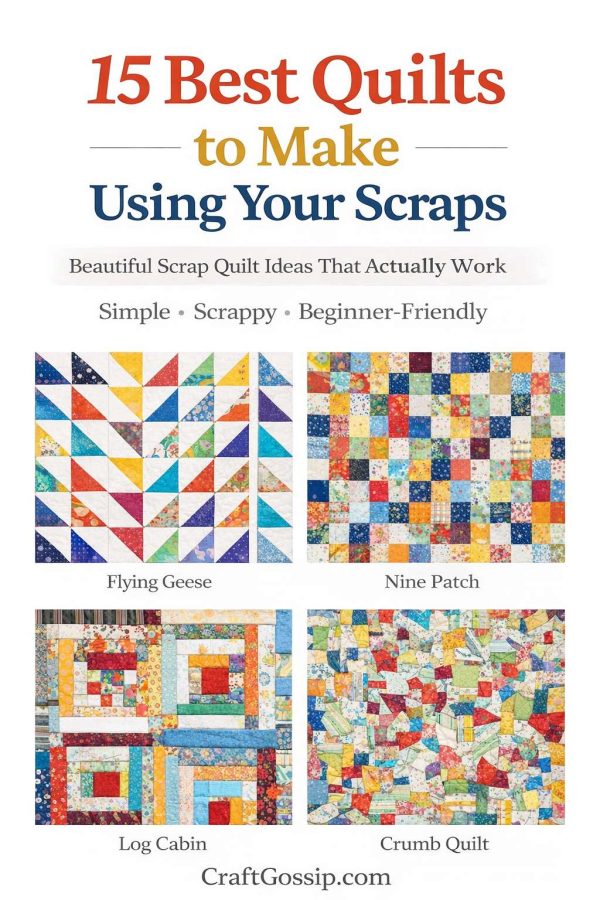
15 Best Quilts to Make Using Your Scraps (Beautiful Scrap Quilt Ideas That Actually Work)

If you’ve ever stood in your sewing room staring at a basket of fabric scraps thinking, “I should do something with these,” this article is for you.

Scrap quilts aren’t just practical — they’re often the most joyful quilts we make. They’re forgiving, colorful, and deeply personal. Every leftover piece carries a memory from a past project.

If you’re searching for the best quilts to make using your scraps, this guide goes beyond inspiration. We’ll talk about which patterns truly work for scraps, how to keep them looking cohesive, how much fabric you actually need, and which scrap sizes suit which designs.

Let’s turn that scrap pile into something intentional.

Why Scrap Quilts Are So Popular (And Why They Work)

Scrap quilts continue to trend because they:

  • Reduce fabric waste
    • Use leftovers from past projects
    • Feel nostalgic and personal
    • Save money
    • Encourage creativity without pressure

Unlike tightly planned quilts, scrap quilts allow flexibility. Slight variations in tone, scale, and print aren’t flaws — they’re part of the charm.

And for many of us, they’re emotionally satisfying. That tiny floral from a baby quilt? It shows up again in a new design.

What Makes a Quilt Pattern Truly Scrap-Friendly?

Not every quilt pattern works well with mixed fabrics.

The best scrap quilt patterns share these traits:

  • Repeated simple blocks
    • Uniform block size
    • No reliance on large focal prints
    • Strong layout grid
    • Balance of light and dark values

The structure holds the design together while the scraps bring personality.

If a pattern depends on exact color placement or large uninterrupted shapes, it’s usually not ideal for scraps.

1. Half Square Triangle Scrap Quilt

This is the ultimate scrap quilt.

Half square triangles (HSTs) use small squares and create endless layout possibilities.

Why it works beautifully for scraps:

  • Uses small pieces efficiently
    • Easy to chain piece
    • Allows strong contrast
    • Works with controlled or random color placement

You can create:

  • Chevron layouts
    • Diamonds
    • Broken dishes
    • Pinwheels
    • Modern gradient quilts

If you’re unsure what to do with your scraps, start here.

2. Crumb Quilt (Tiny Scraps Welcome)

If your scraps are small and irregular, crumb quilting is magic.

Instead of cutting into precise shapes, you sew scraps together randomly into larger “slabs,” then trim into blocks.

Why crumb quilts shine:

  • Uses the smallest pieces
    • No strict measuring
    • Highly forgiving
    • Great for improv lovers

Crumb quilts look chaotic mid-process — but once assembled, they’re surprisingly cohesive.

3. String Quilt

String quilts use narrow strips sewn onto a foundation.

Perfect for:

  • Long skinny leftovers
    • Binding offcuts
    • Strips trimmed from squaring blocks

You can sew strips diagonally, vertically, or randomly. When blocks are squared up, the quilt looks deliberate.

String quilts are fantastic for beginners because seam accuracy is less stressful.

4. Log Cabin Scrap Quilt

A true classic.

Log cabin blocks use strips built around a center square.

Why it works for scraps:

  • Uses varying strip lengths
    • Creates strong light/dark contrast
    • Looks intentional even when scrappy

Keep your center squares consistent for visual balance.

5. Nine Patch Scrap Quilt

Simple.
Reliable.
Endlessly adaptable.

Nine patch blocks use small squares — perfect for 2½” or 3½” scrap cuts.

Why it works:

  • Quick to assemble
    • Easy chain piecing
    • Beginner-friendly

Alternate with solid blocks or add sashing for structure.

6. Flying Geese Scrap Quilt

If you have medium-sized scraps, flying geese blocks are ideal.

Scrappy geese with a consistent background fabric prevent visual overload.

They create strong directional movement across a quilt top.

7. Irish Chain Scrap Quilt

This block balances structure with randomness.

Scrappy chain units combined with solid blocks create breathing space.

It’s a beautiful option if you want scrap charm without chaos.

8. Checkerboard Scrap Quilt

Sometimes the simplest layouts are the most powerful.

Equal-sized squares in alternating placement create a bold grid.

This design works best when you pay attention to light vs dark balance.

9. Sawtooth Star Scrap Quilt

Scrappy star points paired with solid backgrounds create stunning contrast.

You can keep star centers consistent for cohesion.

It feels classic but works beautifully in modern color palettes.

10. Rail Fence Scrap Quilt

Strip-based and fast to assemble.

Rotate blocks to create zigzags or woven effects.

This quilt is ideal for 2½” strip scraps.

11. Postage Stamp Quilt

If you love tiny pieces, this is your project.

Small squares sewn into a dense grid create a pixelated effect.

Time-consuming — but breathtaking.

12. Broken Dishes Quilt

Made entirely from half square triangles.

It creates a shattered-glass pattern that looks far more complex than it is.

High-contrast scraps work best here.

13. Pineapple Scrap Quilt

For confident quilters.

This design uses small strips in layered rotation around a center.

It’s intricate and dramatic — perfect for organized scrap bins.

14. Modern Negative Space Scrap Quilt

Use scrap blocks surrounded by solid white or low-volume background.

The empty space allows the scrap sections to shine without overwhelming the eye.

15. Sampler Scrap Quilt

Combine multiple scrap-friendly blocks into one quilt.

It keeps things interesting and prevents fabric fatigue.

Perfect if you enjoy variety.

How to Keep Scrap Quilts From Looking Too Busy

This is where many scrap quilts struggle.

Here’s how to maintain cohesion:

  • Use a consistent background fabric
    • Limit to 2–3 color families
    • Balance warm and cool tones
    • Keep block size uniform
    • Add sashing if needed

Even the wildest scrap quilt benefits from repetition.

Sorting Your Scraps Before You Start

Instead of dumping everything into one pile, try sorting by:

  • Light / medium / dark
    • Color family
    • Strip vs square vs crumb
    • Tone (warm vs cool)

This makes choosing patterns easier.

If your scraps are mostly small:
Choose crumb, nine patch, or postage stamp.

If mostly strips:
Choose string, log cabin, rail fence.

If medium cuts:
Flying geese or HSTs are ideal.

How Much Fabric Do You Actually Need?

One common question is:

“How many scraps do I need for a quilt?”

Here’s a rough estimate for a throw-size scrap quilt (60″ x 72″):

  • Approximately 4–5 yards total scrap volume combined
    • Background fabric may require 2–3 yards
    • Binding ½ yard
    • Backing 4 yards

Because scraps vary in size, it’s better to measure by total coverage rather than count.

Scrap Quilt Color Strategy That Works

The secret to beautiful scrap quilts isn’t matching fabrics — it’s controlling value.

Value contrast (light vs dark) matters more than print style.

If everything is medium tone, the quilt will look flat.

Make sure you have:

  • Strong dark fabrics
    • Clear lights
    • A few medium fillers

Squint at your layout. If shapes disappear, you need stronger contrast.

Why Scrap Quilts Feel So Special

Scrap quilts aren’t just practical.

They’re memory quilts without trying to be.

That floral from your daughter’s skirt.
That neutral from a farmhouse pillow.
That bold print from a modern quilt you tried.

They all come together in one place.

That’s why scrap quilts feel layered with story.

Final Thoughts on the Best Quilts Using Your Scraps

The best scrap quilt isn’t the fanciest one.

It’s the one that uses what you already have.

Start simple.
Focus on contrast.
Trim carefully.
Trust the repetition.

Your scrap pile isn’t clutter.
It’s potential.

Categories

Christmas quilts Craft Competitions Craft News and Events Free Quilt Patterns Modern More Quilting Patterns & Projects Quilting Art Quilts Quilting Blocks Quilting Books Quilting Contest Quilting Events Quilting Fabric Quilting Gift Ideas Quilting How To & Tutorials Quilting Inspiration Quilting Products Quilting Technique Scrap Fabric Tutorials and Patterns

RSS feed: More Articles More Articles

  • Knitting Machine Scarves with a Fun Twist
  • Gross Motor Math Ideas
  • 12 Free Crochet Vest Patterns for Easy, Wearable Layers
  • 5 Things To Do With That Odd Leftover Jar Of Thumbtacks
  • Crochet Octopus Patterns: Cute Minis, Squishy Plushies and Sea-Life Projects
  • 30 Handmade Christmas Gifts You Can Send in a Card or Envelope
  • Girl in Meadow Hand Embroidery Pattern – Etsy Review
  • Disney Themed Halloween Mini Scrapbook Album
  • Baby Bonnet Crochet Patterns for Sweet Handmade Gifts
  • 8 Knitted Crown Patterns for Children and Adults

Copyright © 2026 · CraftGossip | Start Here | Contact Us | Link to Us | Your Editors | Privacy and affiliate policy