• Home
  • Suggest A DIY
  • DIY Newsletter

Quilting

Patterns, patchworks and projects

  • About CraftGossip
  • Our Network
    • Bath & Body Crafts
    • Candle Making Ideas
    • Crochet Ideas
    • Cross Stitch
    • Edible Crafts
    • Felting Patterns
    • Glass Art
    • Home & Garden Ideas
    • Indie Crafts
    • Jewelry Making
    • Kids Crafts
    • Knitting Patterns
    • Lesson Plans
    • Needlework
    • Party Ideas
    • Polymer Clay
    • Quilting Ideas
    • Recycled Crafts
    • Scrapbooking
    • Sewing Patterns
    • Card Making
    • DIY Weddings
    • Not Craft Ideas
  • Giveaways
  • Roundups
  • Store
  • Search

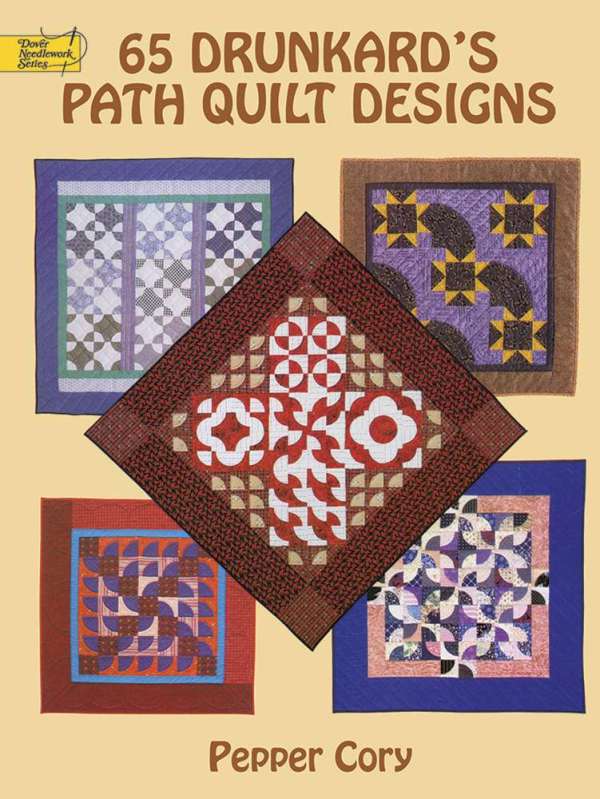
Book Review – 65 Drunkard’s Path Quilt Designs

April 9, 2023 by Shellie Wilson

If you’ve always wanted to try the beautifully meandering Drunkard’s Path pattern but were put off by its reputation for difficulty, there’s good news: aid is on the way. Anyone can learn to piece this appealing, time-honored pattern using the step-by-step instructions and detailed drawings in this expert tutorial.

Why is it called Drunkard’s Path?

The Drunkard’s Path quilt design is a classic pattern in quilting that has been around for centuries. It is a block-based pattern that is made up of curved pieces that create a circular or swirling effect when pieced together.

The name “Drunkard’s Path” is said to have originated from the pattern’s resemblance to the erratic path of a drunk person. The design is made up of two curved pieces, one concave and one convex, that fit together to create a circle or arc.

The Drunkard’s Path design can be arranged in a variety of ways, creating different looks and effects. Some common arrangements include alternating blocks of the same color, creating a checkerboard effect, or using a range of colors to create a gradient effect.

The pattern can be made using a variety of quilting techniques, including hand piecing, machine piecing, and applique. It can also be combined with other quilt block patterns to create more complex designs.

The Drunkard’s Path quilt design is popular among quilters because it is both challenging and rewarding to piece together. It requires a high level of precision to ensure that the curves fit together perfectly, but the end result is a stunning and unique quilt that is sure to impress.

Pepper Cory, an internationally known quilting authority, traces the history of the Drunkard’s Path from England and illustrates the pattern’s many engaging variations (including Old Maid’s Puzzle, Rob Pete to Pay Paul, Tumbleweed, and more) while offering advice on every stage of the quilting process, from selecting fabrics and making templates to designing layouts and mastering the tricky curves.

Get it here: Drunkard’s Path pattern
«
»

Have you read?

United We Stitch Invites Quilters and Textile Artists to Imagine the Future of Democracy

Quilts have never been just about keeping warm.

They have recorded family histories, marked important events, carried political messages, remembered people we have lost and given communities a way to say something together when ordinary words somehow don’t feel quite enough.

A new nationwide textile project called United We Stitch is tapping into that long tradition and inviting quilters, embroiderers, fibre artists and everyday makers across America to answer one deceptively simple question:

What do you imagine for the future of democracy?

And instead of answering it with an essay or a social media post, participants are being asked to answer with fabric and thread.

What Is United We Stitch?

United We Stitch is a community textile-art initiative inviting people across the United States to create a 3-foot by 5-foot textile panel, roughly the size of a flag.

The interpretation is deliberately broad.

Makers can work with fabric, thread, yarn, fibre and mixed-media elements, which means your contribution doesn’t necessarily need to look like a traditional patchwork quilt.

You might use:

  • quilting
  • appliqué
  • embroidery
  • hand stitching
  • yarn and crochet
  • fabric collage
  • visible mending
  • mixed-media textile techniques
  • meaningful scraps, clothing or keepsake fabrics

The theme is simply:

“Imagine the Future of Democracy.”

That leaves an enormous amount of room for personal interpretation.

A panel might explore community, equality, freedom, peace, belonging, voting, family, opportunity, hope or simply what you would like the next generation to inherit.

Quilting Has Always Told Bigger Stories

If this sounds familiar, that’s because textile art has been used to record social history for generations.

We recently explored this in our feature on resistance quilts and how patchwork becomes protest.

From suffrage-era textiles to the AIDS Memorial Quilt and today’s social-justice quilts, cloth has an unusual ability to make big subjects feel personal.

A banner printed in a factory can communicate a message instantly.

A quilt communicates something slightly different.

Someone chose every piece of fabric.

Someone cut it.

Someone sat there stitching it.

There is time embedded in handmade work, and I think that is part of what makes textile activism so powerful.

You Don’t Need to Be a Professional Textile Artist

One of the things I like about the idea behind United We Stitch is that participation isn’t restricted to professional artists.

The project is calling for creatives, advocates, community members and everyday citizens to contribute.

So don’t look at the 3 x 5 foot size and immediately decide your points aren’t perfect enough.

This isn’t a quilt-show challenge where someone is going to appear with a ruler and inspect your quarter-inch seams.

The message is the project.

If you’ve been curious about using your craft to say something beyond “this fabric was too pretty to leave in the shop,” you might also enjoy our review of Let’s Move the Needle: An Activism Handbook for Artists, Crafters, Creatives, and Makers.

That book looks specifically at the idea of craftivism, using the skills we already have as makers to create conversations and build community.

We’ve also reviewed Crafting a Better World by Diana Weymar, which explores the same idea through embroidery and other creative projects.

When Will the United We Stitch Exhibition Take Place?

The project is working toward a nationwide exhibition on September 20, 2026.

That date was deliberately chosen to coincide with the International Day of Peace.

The idea is that individual textile panels created in communities across the country will become part of a much larger collective display.

And I think that scale is what makes this particularly interesting.

One 3 x 5 foot textile panel tells one person’s story.

Hundreds or thousands of them displayed together start telling a story about what an entire collection of communities hope for.

What Would You Stitch?

This is the part I keep coming back to.

If somebody handed you a piece of fabric and asked you to stitch your hopes for the future onto it, what would you make?

Would you use words?

Traditional quilt blocks?

Old clothing?

Family photographs transferred onto fabric?

A flag?

A map?

Flowers?

Hands?

A house?

Would you make something colourful and optimistic, or something that acknowledges difficult parts of the present before looking toward something better?

There really isn’t one correct answer, which is exactly what makes a collaborative textile project like this interesting.

If you’ve been wanting to make a quilt with a message but weren’t sure where to begin, the practical design ideas in our Resistance Quilts guide are a useful starting point, particularly for incorporating appliquéd words, clothing, symbolic colours, photographs and personal stories.

How to Get Involved

Makers interested in taking part can find current participation information and project details through United We Stitch.

With the nationwide exhibition planned for September 20, 2026, this is also one of those projects I wouldn’t leave sitting in the “I’ll think about that later” pile for too long.

We crafters all know what happens to that pile.

Suddenly the deadline is next Tuesday and we’re sewing binding at 1:30 in the morning.

Whether your panel is intricate and heavily quilted or made from simple scraps and hand stitching, the interesting part is that it becomes one small piece of a much bigger textile conversation.

And perhaps that’s a rather fitting way to imagine the future in the first place.

Lots of individual pieces, not necessarily identical, stitched together into something larger.

Categories

Christmas quilts Craft Competitions Craft News and Events Free Quilt Patterns Modern More Quilting Patterns & Projects Quilting Art Quilts Quilting Blocks Quilting Books Quilting Contest Quilting Events Quilting Fabric Quilting Gift Ideas Quilting How To & Tutorials Quilting Inspiration Quilting Products Quilting Technique Scrap Fabric Tutorials and Patterns

RSS More Articles

  • Free Felted Woodland Mini Mending Pattern Review
  • Free Felting Tutorial Friday: Needle Felted Dragonfly
  • Knit a Hood for Your Fall Wanderings
  • Book Review: Borders
  • How to Make a Cute Teddy Bear Mini Journal
  • United We Stitch Invites Quilters and Textile Artists to Imagine the Future of Democracy
  • Free Plaid Crochet Throw Pattern Review
  • How to Make a DIY Detox Hair and Scalp Mask for Product Buildup
  • AITA for Charging Extra for Rush Orders (Even Though I Work From Home)
  • Cross Stitch a Job and Get a Jump on Holiday Crafting

Copyright © 2026 · CraftGossip | Start Here | Contact Us | Link to Us | Your Editors | Privacy and affiliate policy