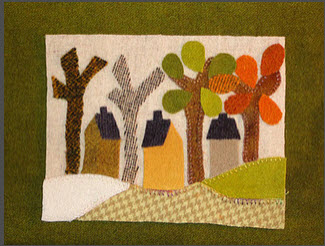
 The talent behind Sunflower Fields Pattern Company made this lovely wool embroidery piece, the first in a series. Once the top is complete, she’ll size to 5″ x 7″ then sew into a pillow. Lovely. Click HERE to read more.
Have you read?
How to Turn Any Quilt Pattern Into a Scrap Quilt (Without It Looking Messy)
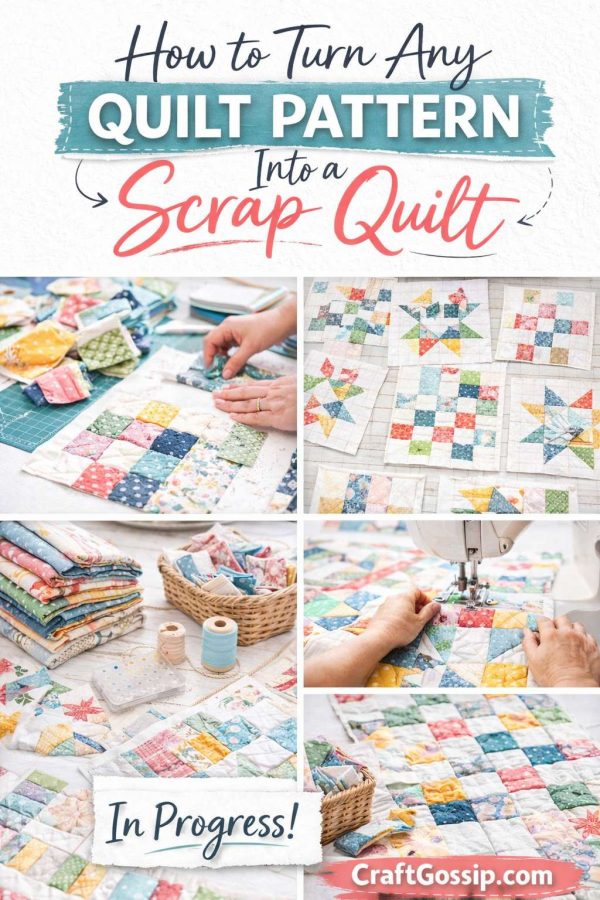
There comes a moment in every quilter’s life when the scrap bin starts judging you.
It’s overflowing. It’s slightly chaotic. And yet… you can’t throw any of it away because “that tiny floral might be perfect one day.”
If you’ve ever wondered how to scrapify a quilt pattern, or how to turn a regular quilt design into a cohesive scrap quilt, this guide is for you.
Because yes — you can turn almost any quilt pattern into a scrap quilt.
And no — it doesn’t have to look chaotic.
What Does “Scrapifying” a Quilt Pattern Mean?
Scrapifying simply means taking a standard quilt pattern — one that usually calls for specific fabrics — and replacing those fabrics with a mix of coordinating scraps.
Instead of:
- Fabric A
- Fabric B
- Fabric C
You use:
- Multiple small cuts within one color family
- Assorted low-volume prints
- Mixed tone-on-tone scraps
The structure stays the same.
Only the fabric selection changes.
Step 1: Choose the Right Quilt Pattern to Scrapify
Not every quilt pattern responds equally well to scrappy treatment.
The easiest quilt patterns to turn into scrap quilts are:
- Log Cabin blocks
- Irish Chain quilts
- Rail Fence quilts
- Half-Square Triangle layouts
- Star block quilts
- Nine Patch quilts
Why? Because they have repetition and structure.
The more structured the block, the better it handles variety.
If you’re a beginner, start with a simple block quilt layout. Avoid complex appliqué or highly detailed modern designs for your first scrap conversion.
Step 2: Decide What Stays Consistent
This is the secret to a beautiful scrap quilt.
When you scrapify a quilt pattern, something must stay consistent.
You can keep consistent:
- The background fabric
- The block center
- The sashing
- One repeating color
- The value (light or dark balance)
If everything changes, the quilt feels chaotic.
If one element repeats, the quilt feels intentional.
For example:
Make all star centers navy.
Keep all backgrounds white.
Use the same grey sashing between blocks.
That one repeating anchor ties the whole quilt together.
Step 3: Control Color Flow (Instead of Using Everything at Once)
When turning a quilt pattern into a scrap quilt, resist the urge to use every fabric immediately.
Instead:
Option A: Scrap Within a Color Family
Example: All blues for one block unit.
Option B: Rainbow Scrappy
Assign one color per block row.
Option C: Controlled Scrappy
Mix prints, but limit to 5–7 dominant colors.
This keeps the design cohesive and prevents visual overload.
Step 4: Pay Attention to Value (Light vs Dark)
Value matters more than print.
You can mix florals, geometrics, polka dots, and stripes — but if all the fabrics are medium tone, the quilt will look flat.
When scrapifying a quilt pattern:
- Pair lights with darks
- Add contrast in block units
- Step back and squint at your layout
If the shapes disappear when you squint, you need more contrast.
This one trick alone makes a scrap quilt look professionally designed.
Step 5: Use a Design Wall (Or the Floor)
Before sewing everything together, lay it out.
Walk away.
Come back.
Rearrange.
Scrap quilts require visual editing.
Sometimes two fabrics sit next to each other and fight. Separate them. Spread colors evenly. Balance heavy prints across the quilt.
This is where the magic happens.
Step 6: Add Sashing If Needed
If your scrapified quilt starts looking busy, add sashing.
Solid sashing:
- Creates breathing space
- Separates strong prints
- Adds polish
- Makes the quilt look modern
White, cream, soft grey, or even black sashing can completely transform a busy scrap layout into a cohesive design.
Example: How to Scrapify Popular Quilt Patterns
Let’s break it down practically.
Scrapifying a Log Cabin Quilt
Instead of two solid fabrics:
- Make the light side scrappy light prints
- Make the dark side scrappy darker prints
Keep the center square consistent.
Instant scrappy charm — zero chaos.
Scrapifying a Star Quilt Pattern
Use:
- Scrappy star points
- Consistent background
- Repeating center color
The star shape stays crisp while the fabric mix adds personality.
Scrapifying a Rail Fence Quilt
Use multiple strips within the same color family for each block.
For example:
Block 1: Assorted blues
Block 2: Assorted greens
Block 3: Assorted reds
It looks intentional instead of random.
Scrapifying a Nine Patch Quilt
Make:
- Corner squares scrappy
- Center square consistent
Or reverse it.
Nine patch quilts are forgiving and ideal for scrap conversion.
Common Scrapifying Mistakes to Avoid
If your scrap quilt feels “off,” check for these issues:
- No consistent background
- Too many high-volume prints
- All fabrics same value
- No repeated color anchor
- Skipping layout testing
Scrap quilts need editing.
They’re creative — but they still need structure.
How to Make Scrap Quilts Look Modern
If you prefer a modern scrap quilt look:
- Use lots of negative space
- Stick to low-volume backgrounds
- Limit color palette
- Use bold graphic blocks
- Keep block layout clean and minimal
Modern scrap quilts often look curated rather than busy.
Best Beginner Quilt Patterns to Scrapify
If you’re new to scrap quilting, start here:
- Rail Fence
- Checkerboard
- Simple Grid Layout
- Nine Patch
- Half-Square Triangle quilts
These are easy to control visually and build confidence fast.
Why Scrap Quilting Is Worth It
Scrap quilts tell stories.
Every fabric piece came from something — a baby quilt, a dress, a project that didn’t quite work out.
When you turn a quilt pattern into a scrap quilt, you’re not just saving fabric.
You’re layering memory into structure.
And honestly? Those quilts often become the ones we reach for the most.
If your scrap bin is staring at you right now, consider this your permission slip.
Pick a simple quilt pattern.
Choose one thing to keep consistent.
Start stitching.
You don’t need perfection.
You just need intention.