• Home
  • Suggest A DIY
  • DIY Newsletter

Quilting

Patterns, patchworks and projects

  • About CraftGossip
  • Our Network
    • Bath & Body Crafts
    • Candle Making Ideas
    • Crochet Ideas
    • Cross Stitch
    • Edible Crafts
    • Felting Patterns
    • Glass Art
    • Home & Garden Ideas
    • Indie Crafts
    • Jewelry Making
    • Kids Crafts
    • Knitting Patterns
    • Lesson Plans
    • Needlework
    • Party Ideas
    • Polymer Clay
    • Quilting Ideas
    • Recycled Crafts
    • Scrapbooking
    • Sewing Patterns
    • Card Making
    • DIY Weddings
    • Not Craft Ideas
  • Giveaways
  • Roundups
  • Store
  • Search

Quilty podcasts

March 25, 2010 by Scarlett Burroughs

 The International Quilt Study Center and Museum offers many podcasts on my favorite subject – quilting. Here’s a current list. Go to their podcasts page and check it out.

  1. “Snail Trails, Broken Dishes and a Streak of Lightning” by Mary Anne Jordan
  2. “An Aesthetic Life: the Story of Quiltmaker Rose Kretsinger” Jonathan Gregory
  3. “Childhood Treasures: Quilts Made for and by Children” Mary Ghormley
  4. “Chintz: Indian Textiles for the West” Rosemary Crill
  5. “Colonial Revival Influence on Quilt Design” Dr. Virginia Gunn
  6. “Contemporary Quiltmaking” Nancy Crow
  7. “From Fibers to Fieldwork” Nao Nomura
  8. “It’s Fashionable to be Pennsylvania Dutch Today: Disseminating Traditional Design in a Modern World.” Janneken Smucker
  9. “Like Gulliver’s Clothes: Early British Patchwork” Bridget Long
  10. “Meet the Makers: American Quilts in the Modern Age” Dr. Patricia Crews
  11. “Modern, Yet Anti-Modern: Two Sides of the Late-Nineteenth and Early-Twentieth Century Quiltmaking” Marin Hanson
  12. “Nebraska Quiltmakers”, Dr. Patricia Crews
  13. “Our Mothers’ Knees” Jean Ray Laury
  14. “Patchwork and Quilting in the UK” Dr. Sue Marks
  15. “Perfecting the Past: Colonial Revival Quilts” Melissa Slaton
  16. “Quilt Surface Design Symposium: Incubating the Innovative Quilt” Michael James
  17. “Quilts in Common” Jonathan Holstein
  18. “Quilts: Reflections of Trade, Technology & Tradition” Dr. Patricia Crews
  19. “Recycling and Resourcefulness: Quilts of the 1930s” Merikay Waldvogel
  20. “Reflections of a Traveling Quiltmaker/Teacher: What Have We Learned?” Paulette Peters
  21. “The American Quilt and the Grammar of Two-Dimensional Design” David Hornung
  22. “The Ingenious and the Spiritual: How and Why We Make Things” Stuart Kestenbaum
  23. “The Underground Railroad Quilt Controversy: Looking for the ‘Truth'” Laurel Horton

These podcasts are for personal use or educational purposes only.

[tags]quilt history, videos, teachers, University of Nebraska-Lincoln[/tags]
«
»

Have you read?

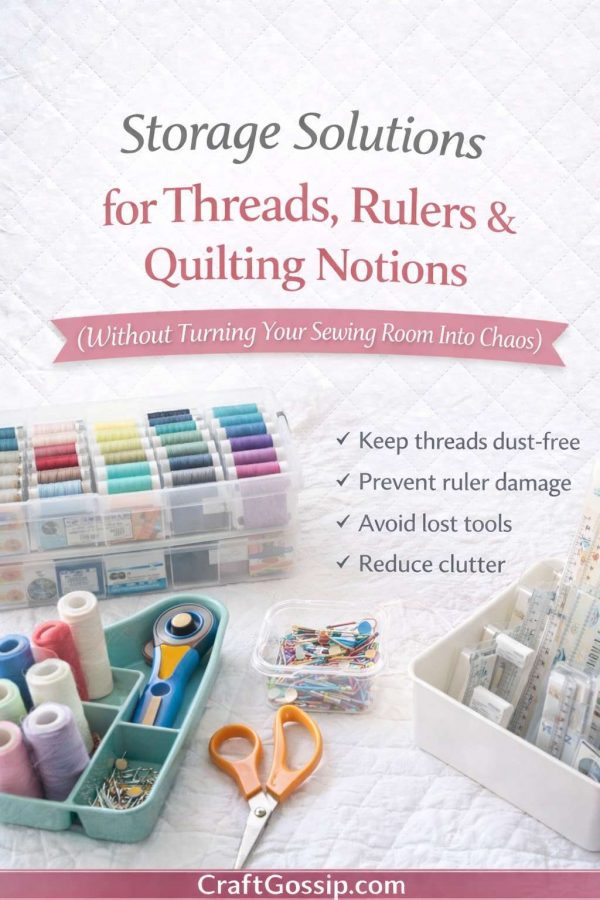
Storage Solutions for Threads, Rulers and Quilting Notions (Without Turning Your Sewing Room Into Chaos)

If you’ve ever spent ten minutes looking for your seam ripper… only to find three of them later in the same drawer…

You are officially a quilter.

Notions multiply. Threads roll. Rulers slide behind furniture. And suddenly your “creative space” feels more like a scavenger hunt.

The good news? Organising quilting notions doesn’t require a studio makeover. It just requires a few smart systems.

Let’s talk practical storage — the kind that works for hobby quilters in real homes.

Why Notion Storage Actually Matters

Organisation isn’t about perfection.

It’s about:

  • Saving time
    • Protecting tools
    • Reducing frustration
    • Extending the life of your supplies

Bent rulers, dusty thread, dull rotary blades — these are often storage issues, not product failures.

A little structure keeps your tools working better for longer.

Thread Storage: Keep It Clean & Protected

Thread doesn’t love:

  • Dust
    • Direct sunlight
    • Extreme humidity

Over time, exposure can weaken fibres and fade colours.

Best thread storage options:

Clear plastic thread boxes
Stackable containers
Drawer inserts
Wall racks (away from windows)

If you have a growing thread collection, separating neutrals from colours can make project prep faster.

Specialty quilting retailers like Fat Quarter Shop offer thread storage containers designed specifically to hold standard spool sizes, which prevents tipping and tangling.

Ruler Storage: Prevent Warping & Chipping

Quilting rulers are acrylic — and acrylic scratches and chips.

Avoid:

  • Stacking them loosely
    • Storing them near heat
    • Sliding them under heavy items

Better options:

Vertical ruler racks
Wall-mounted holders
Magazine-style file organisers
Dedicated shelf slots

Keeping rulers upright prevents edge damage and keeps grid lines visible and readable.

Rotary Cutters & Scissors: Safety First

Blades should always be stored:

  • Closed
    • Covered
    • Away from fabric

Loose rotary cutters in drawers can dull quickly and become dangerous.

Consider:

Tool caddies
Magnetic strips
Dedicated sewing trays

Replace blades regularly and store extras in labelled containers.

Small Notions: The Drawer Trap

Pins. Clips. Seam rippers. Needle packs. Chalk.

These tiny tools disappear easily.

Solutions that actually work:

Clear divided containers
Craft tackle boxes
Small labelled bins
Magnetic dishes for pins

If you constantly rebuy small tools, it’s usually a visibility problem — not a usage problem.

Batting Storage: Keep It Lofty

Batting compresses if stored tightly.

Avoid vacuum sealing unless long-term storage is necessary.

Better options:

Rolled storage
Breathable bins
Shelf stacking (not crushed)

Store away from moisture to prevent fibre damage.

Portable Storage for Hobby Quilters

If your sewing space doubles as a dining table or spare room, portability matters.

Rolling carts
Stackable bins
Handled totes
Foldaway caddies

These allow you to set up and pack down without chaos.

You don’t need a dedicated sewing room to feel organised.

Label Everything (Future You Will Thank You)

Clear labelling:

  • Saves time
    • Prevents overbuying
    • Keeps projects moving

Simple adhesive labels or printed tags work beautifully.

When Storage Improves Quilting Results

Organisation isn’t just aesthetic.

It:

  • Reduces tool damage
    • Makes accurate tools easier to access
    • Encourages regular needle changes
    • Keeps thread dust-free

A tidy system often leads to smoother quilting sessions.

The Bottom Line for Hobby Quilters

You don’t need custom cabinetry.

Start with:

  • Clear thread storage
    • Upright ruler storage
    • Divided containers for small tools
    • A safe place for rotary cutters

Build slowly. Upgrade as your collection grows.

Quilting should feel calming — not cluttered.

This article is part of our Ultimate Guide to Quilting Notions for Hobby Quilters, where we focus on tools that improve your quilting experience without overwhelming you.

Next in the series:
Lighting for Quilters: Reduce Eye Strain & Improve Accuracy


Categories

Christmas quilts Craft Competitions Craft News and Events Free Quilt Patterns Modern More Quilting Patterns & Projects Quilting Art Quilts Quilting Blocks Quilting Books Quilting Contest Quilting Events Quilting Fabric Quilting Gift Ideas Quilting How To & Tutorials Quilting Inspiration Quilting Products Quilting Technique Scrap Fabric Tutorials and Patterns

RSS feed: More Articles More Articles

  • Knit a Sweet Blanket with a Pocket for Treasures
  • Cute Halloween Scrapbook Mini Album
  • Breast Cancer Care Package In A Jar – A Thoughtful Pink Ribbon Gift You Can Make In Minutes
  • Designer Spotlight: And Wabi Sabi
  • Stitch a Play Mat with a Gorgeous Butterfly
  • 20 Non-Candy Halloween Treat Ideas for Kids, Classrooms and Trick-or-Treaters
  • DIY Snowman Door Hanger Using Tulle and Fairy Lights
  • Whipped Manuka Honey Body Butter – Ultra-Rich DIY Moisturizer for Dry, Mature Skin
  • How to Wet Felt an Embellished Clutch Purse by Natasha Smart Textiles
  • 10 Cute Halloween Scrapbook Layout Ideas

Copyright © 2026 · CraftGossip | Start Here | Contact Us | Link to Us | Your Editors | Privacy and affiliate policy