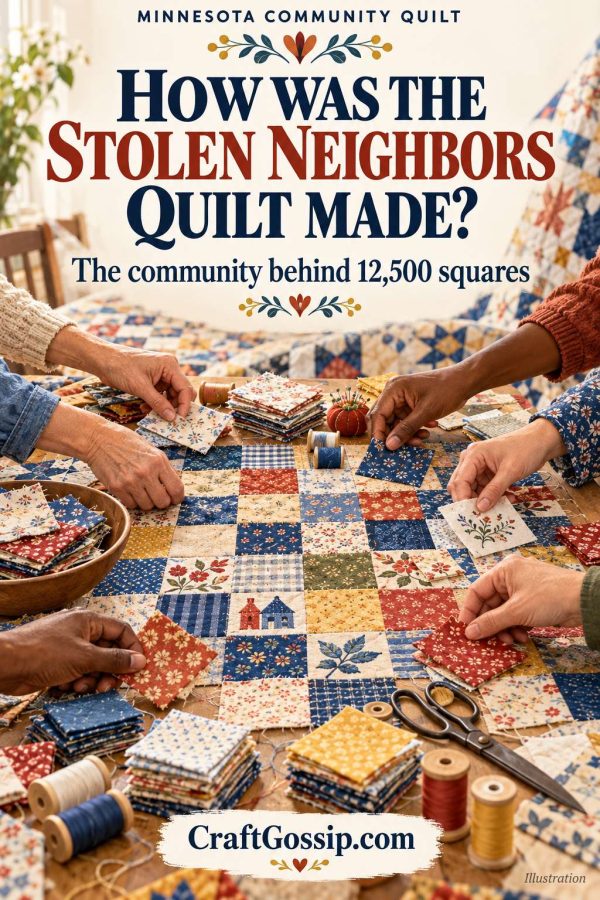
When I first heard about the Stolen Neighbors Quilt, I pictured a group of quilters working on something enormous. Then I learned that the finished piece contains 12,500 squares. If you have ever tried to keep even a modest block swap organised, you can imagine the planning, sorting and sewing behind that number.
The Minnesota Stolen Neighbors Quilt was unveiled at the Minnesota State Capitol in Saint Paul on 22 September 2026. The project began with a goal of 11,000 squares, intended by its organisers to represent Minnesota immigrants taken into federal immigration custody during the period they were documenting. Contributions exceeded that goal. One of the organisers reported that the finished quilt measures approximately 9 feet by 33 feet.
For readers searching from Australia, you may also have seen it called the Stolen Neighbours Quilt. The project itself uses the US spelling, Neighbors.
Who made the Stolen Neighbors Quilt?
The idea came from Owen Lubozynski, who launched the project with Melissa Greene in April 2026. More than 150 people contributed to the effort over roughly six months. Squares came from people in Minnesota and elsewhere in the United States, while volunteers helped turn the contributions into one large textile work.
It took more than donated squares. Local shops including Lakes Makerie, Knit and Bolt, and the Sewing Lounge donated fabric. The Textile Center served as a hub for volunteer sewers. Art Buddies worked with children at Whittier Elementary School to illustrate more than 100 squares.
That mixture of contributors is one of the most moving parts of the project for me. A community quilt does not need every square to look as though it came from the same sewing room. The differences show how many people took part.
What do the squares mean?
The quilt was created to draw attention to immigration detentions in Minnesota. Organisers chose a repeated fabric square as a way to make a large number visible, with each square intended to represent one person. Some contributed pieces include messages such as “No Stolen Neighbors” and “ICE Out.”
The organisers’ original target was 11,000 squares. An account of the unveiling by one of the project organisers says the completed quilt contains 12,500. That explains why early coverage and social posts sometimes describe it as an “11,000-square quilt.”
The work behind a quilt this size
The organisers have shared the scale of the project and the people who helped, though I have not found a complete public construction pattern. I would not want to guess at the exact cutting sizes, seam allowances or assembly method from photographs.
Any quilter can still appreciate the practical challenge. Contributions from many hands need to be received and kept track of. Sections have to be joined into a piece that can be handled, carried and displayed. When the quilt was unveiled, people unfurled it inside the Capitol rotunda and then carried it outside to the Capitol steps.
That is a useful reminder for anyone planning a group quilt: decide how the finished work will travel and where it will hang before the blocks begin arriving. A design that looks manageable on a table may be quite another matter when a dozen people have to lift it.
The Stolen Neighbors Quilt is a striking example of what happens when small pieces of work become one collective statement. If you are interested in other ways makers have used cloth to speak about issues they care about, our guide to resistance quilts and protest patchwork is a place to explore more projects.
You can see photographs and read an account of the unveiling. Take a moment to look at both the full quilt and its individual squares. The view from a distance tells one story; the work of all those contributors tells another.