• Home
  • Suggest A DIY
  • DIY Newsletter

Quilting

Patterns, patchworks and projects

  • About CraftGossip
  • Our Network
    • Bath & Body Crafts
    • Candle Making Ideas
    • Crochet Ideas
    • Cross Stitch
    • Edible Crafts
    • Felting Patterns
    • Glass Art
    • Home & Garden Ideas
    • Indie Crafts
    • Jewelry Making
    • Kids Crafts
    • Knitting Patterns
    • Lesson Plans
    • Needlework
    • Party Ideas
    • Polymer Clay
    • Quilting Ideas
    • Recycled Crafts
    • Scrapbooking
    • Sewing Patterns
    • Card Making
    • DIY Weddings
    • Not Craft Ideas
  • Giveaways
  • Roundups
  • Store
  • Search

Don’t Touch My Quilt: A Guide to Polite Quilt Fair Etiquette

April 19, 2024 by Shellie Wilson

Hey there, fellow quilt enthusiasts! So, you’ve spent countless hours meticulously piecing together your masterpiece, and now it’s finally on display at a quilt fair. There’s just one problem – people can’t seem to keep their hands off it! Don’t worry, I’ve got your back with some tips on how to politely stop those eager fingers from getting too close to your precious quilt.

Set Up Clear Signage: Sometimes people just need a gentle reminder. Consider placing friendly signs near your quilt that kindly ask viewers not to touch . A simple “Please admire with your eyes, not your hands” can work wonders.

Engage with Visitors: Stand near your quilt and strike up conversations with interested viewers. This not only allows you to share the story behind your creation but also acts as a subtle deterrent against unwanted touching.

Be Direct but Polite: If you spot someone reaching out to touch your quilt, don’t be afraid to politely intervene. A friendly “I’m so glad you like it! Please refrain from touching, though – I want to keep it in pristine condition” should do the trick.

Use Physical Barriers: If all else fails, consider placing a velvet rope or stanchions around your quilt to create a physical barrier. Most people will understand that it’s off-limits 

Remember, most people don’t realize the potential damage their touch can cause, so approach the situation with patience and understanding. With these strategies in mind, you can confidently display your quilt knowing that it’s safe from unwanted handling. 

So what about all the other stuff? all the silly questions? we have you covered for that too.

Craft Fair FAQ: Answering Customers’ Questions

Where do you get your materials? It’s best not to reveal specific suppliers, but assure customers of the quality of materials used.

Do you offer free shipping like on Etsy? Pricing may differ at craft fairs due to various factors like venue fees and overhead costs.

Why are your prices different here compared to online? Prices may vary between craft fairs and online platforms due to different cost structures.

Can I customize this item? Customization options may be available; if not, alternatives can be suggested.

Are your products handmade? Yes, emphasize the handmade nature of your products and the craftsmanship behind each piece.
«
»

Have you read?

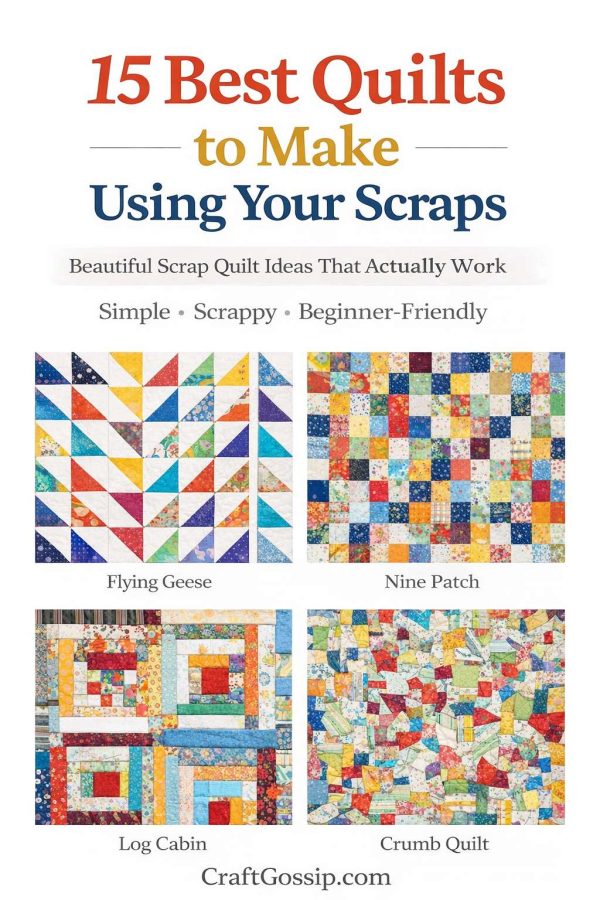
15 Best Quilts to Make Using Your Scraps (Beautiful Scrap Quilt Ideas That Actually Work)

If you’ve ever stood in your sewing room staring at a basket of fabric scraps thinking, “I should do something with these,” this article is for you.

Scrap quilts aren’t just practical — they’re often the most joyful quilts we make. They’re forgiving, colorful, and deeply personal. Every leftover piece carries a memory from a past project.

If you’re searching for the best quilts to make using your scraps, this guide goes beyond inspiration. We’ll talk about which patterns truly work for scraps, how to keep them looking cohesive, how much fabric you actually need, and which scrap sizes suit which designs.

Let’s turn that scrap pile into something intentional.

Why Scrap Quilts Are So Popular (And Why They Work)

Scrap quilts continue to trend because they:

  • Reduce fabric waste
    • Use leftovers from past projects
    • Feel nostalgic and personal
    • Save money
    • Encourage creativity without pressure

Unlike tightly planned quilts, scrap quilts allow flexibility. Slight variations in tone, scale, and print aren’t flaws — they’re part of the charm.

And for many of us, they’re emotionally satisfying. That tiny floral from a baby quilt? It shows up again in a new design.

What Makes a Quilt Pattern Truly Scrap-Friendly?

Not every quilt pattern works well with mixed fabrics.

The best scrap quilt patterns share these traits:

  • Repeated simple blocks
    • Uniform block size
    • No reliance on large focal prints
    • Strong layout grid
    • Balance of light and dark values

The structure holds the design together while the scraps bring personality.

If a pattern depends on exact color placement or large uninterrupted shapes, it’s usually not ideal for scraps.

1. Half Square Triangle Scrap Quilt

This is the ultimate scrap quilt.

Half square triangles (HSTs) use small squares and create endless layout possibilities.

Why it works beautifully for scraps:

  • Uses small pieces efficiently
    • Easy to chain piece
    • Allows strong contrast
    • Works with controlled or random color placement

You can create:

  • Chevron layouts
    • Diamonds
    • Broken dishes
    • Pinwheels
    • Modern gradient quilts

If you’re unsure what to do with your scraps, start here.

2. Crumb Quilt (Tiny Scraps Welcome)

If your scraps are small and irregular, crumb quilting is magic.

Instead of cutting into precise shapes, you sew scraps together randomly into larger “slabs,” then trim into blocks.

Why crumb quilts shine:

  • Uses the smallest pieces
    • No strict measuring
    • Highly forgiving
    • Great for improv lovers

Crumb quilts look chaotic mid-process — but once assembled, they’re surprisingly cohesive.

3. String Quilt

String quilts use narrow strips sewn onto a foundation.

Perfect for:

  • Long skinny leftovers
    • Binding offcuts
    • Strips trimmed from squaring blocks

You can sew strips diagonally, vertically, or randomly. When blocks are squared up, the quilt looks deliberate.

String quilts are fantastic for beginners because seam accuracy is less stressful.

4. Log Cabin Scrap Quilt

A true classic.

Log cabin blocks use strips built around a center square.

Why it works for scraps:

  • Uses varying strip lengths
    • Creates strong light/dark contrast
    • Looks intentional even when scrappy

Keep your center squares consistent for visual balance.

5. Nine Patch Scrap Quilt

Simple.
Reliable.
Endlessly adaptable.

Nine patch blocks use small squares — perfect for 2½” or 3½” scrap cuts.

Why it works:

  • Quick to assemble
    • Easy chain piecing
    • Beginner-friendly

Alternate with solid blocks or add sashing for structure.

6. Flying Geese Scrap Quilt

If you have medium-sized scraps, flying geese blocks are ideal.

Scrappy geese with a consistent background fabric prevent visual overload.

They create strong directional movement across a quilt top.

7. Irish Chain Scrap Quilt

This block balances structure with randomness.

Scrappy chain units combined with solid blocks create breathing space.

It’s a beautiful option if you want scrap charm without chaos.

8. Checkerboard Scrap Quilt

Sometimes the simplest layouts are the most powerful.

Equal-sized squares in alternating placement create a bold grid.

This design works best when you pay attention to light vs dark balance.

9. Sawtooth Star Scrap Quilt

Scrappy star points paired with solid backgrounds create stunning contrast.

You can keep star centers consistent for cohesion.

It feels classic but works beautifully in modern color palettes.

10. Rail Fence Scrap Quilt

Strip-based and fast to assemble.

Rotate blocks to create zigzags or woven effects.

This quilt is ideal for 2½” strip scraps.

11. Postage Stamp Quilt

If you love tiny pieces, this is your project.

Small squares sewn into a dense grid create a pixelated effect.

Time-consuming — but breathtaking.

12. Broken Dishes Quilt

Made entirely from half square triangles.

It creates a shattered-glass pattern that looks far more complex than it is.

High-contrast scraps work best here.

13. Pineapple Scrap Quilt

For confident quilters.

This design uses small strips in layered rotation around a center.

It’s intricate and dramatic — perfect for organized scrap bins.

14. Modern Negative Space Scrap Quilt

Use scrap blocks surrounded by solid white or low-volume background.

The empty space allows the scrap sections to shine without overwhelming the eye.

15. Sampler Scrap Quilt

Combine multiple scrap-friendly blocks into one quilt.

It keeps things interesting and prevents fabric fatigue.

Perfect if you enjoy variety.

How to Keep Scrap Quilts From Looking Too Busy

This is where many scrap quilts struggle.

Here’s how to maintain cohesion:

  • Use a consistent background fabric
    • Limit to 2–3 color families
    • Balance warm and cool tones
    • Keep block size uniform
    • Add sashing if needed

Even the wildest scrap quilt benefits from repetition.

Sorting Your Scraps Before You Start

Instead of dumping everything into one pile, try sorting by:

  • Light / medium / dark
    • Color family
    • Strip vs square vs crumb
    • Tone (warm vs cool)

This makes choosing patterns easier.

If your scraps are mostly small:
Choose crumb, nine patch, or postage stamp.

If mostly strips:
Choose string, log cabin, rail fence.

If medium cuts:
Flying geese or HSTs are ideal.

How Much Fabric Do You Actually Need?

One common question is:

“How many scraps do I need for a quilt?”

Here’s a rough estimate for a throw-size scrap quilt (60″ x 72″):

  • Approximately 4–5 yards total scrap volume combined
    • Background fabric may require 2–3 yards
    • Binding ½ yard
    • Backing 4 yards

Because scraps vary in size, it’s better to measure by total coverage rather than count.

Scrap Quilt Color Strategy That Works

The secret to beautiful scrap quilts isn’t matching fabrics — it’s controlling value.

Value contrast (light vs dark) matters more than print style.

If everything is medium tone, the quilt will look flat.

Make sure you have:

  • Strong dark fabrics
    • Clear lights
    • A few medium fillers

Squint at your layout. If shapes disappear, you need stronger contrast.

Why Scrap Quilts Feel So Special

Scrap quilts aren’t just practical.

They’re memory quilts without trying to be.

That floral from your daughter’s skirt.
That neutral from a farmhouse pillow.
That bold print from a modern quilt you tried.

They all come together in one place.

That’s why scrap quilts feel layered with story.

Final Thoughts on the Best Quilts Using Your Scraps

The best scrap quilt isn’t the fanciest one.

It’s the one that uses what you already have.

Start simple.
Focus on contrast.
Trim carefully.
Trust the repetition.

Your scrap pile isn’t clutter.
It’s potential.

Categories

Christmas quilts Craft Competitions Craft News and Events Free Quilt Patterns Modern More Quilting Patterns & Projects Quilting Art Quilts Quilting Blocks Quilting Books Quilting Contest Quilting Events Quilting Fabric Quilting Gift Ideas Quilting How To & Tutorials Quilting Inspiration Quilting Products Quilting Technique Scrap Fabric Tutorials and Patterns

RSS feed: More Articles More Articles

  • Christmas on a Budget – How to Style Your Christmas Table for Under $50 Without Buying New Tableware
  • 14 Free Crochet Christmas Ornament Patterns for Yarn Scraps and Handmade Gifts
  • 27 FREE Witchy SVG Cut Files and Printables
  • Learn About Greenland for Kids
  • Book Review: Patty Lyons’ Knitting ER
  • 10 Scrapbook Layout Ideas with Mixed Patterns for Fall and Halloween
  • Easy Shortbread Recipe: Buttery Fingers With No Rolling Required
  • Make Rustic Christmas Ribbon from Old Bed Sheets and Tiny Stamps
  • Free Crochet Hot Chocolate Mug Ornament Pattern For Christmas
  • Hanukkah Cross Stitch Projects

Copyright © 2026 · CraftGossip | Start Here | Contact Us | Link to Us | Your Editors | Privacy and affiliate policy