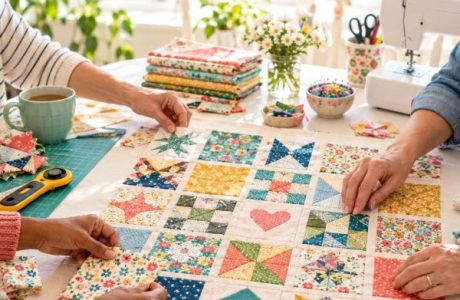
The layout of the book is clean and easy to follow. It doesn’t overwhelm you with dense instructions or complicated diagrams right away. Instead, the early pages ease you into the concept of mosaic quilting and explain how images can be translated into quilt blocks.
As I flipped through, I noticed the instructions focus heavily on breaking images down into manageable pieces. Rather than trying to recreate a photo all at once, the book shows how simple square units can gradually build up a larger image.
It’s a clever approach that feels very similar to pixel art or digital image grids.
The photography throughout the book is also helpful. Seeing the finished quilts alongside the construction steps makes the process feel much less intimidating than you might expect.
What Makes Mosaic Quilting Different
Traditional quilting patterns usually rely on repeating blocks like stars, log cabins, or flying geese. Mosaic quilting takes a different direction.
Instead of repeating blocks, the quilt becomes a kind of fabric grid where colour placement creates the overall image.
That means:
- The quilt design develops gradually as you piece it together
• Fabric colour selection becomes incredibly important
• The finished quilt often looks far more complex than the actual construction
When done well, the results are stunning. Some quilts almost look like digital artwork translated into fabric.
Techniques Covered in the Book
While browsing the book, a few key techniques stood out.
The author spends time explaining how to:
- Convert images into quilt-friendly grids
- Choose fabrics that create shading and depth
- Piece mosaic-style quilts using small square units
- Plan layouts so the final image remains clear and balanced
There’s also a strong emphasis on preparation and planning, which makes sense with this type of quilting. Once you understand how the grid system works, the piecing itself becomes much more straightforward.
Who This Book Is Best For
This book will likely appeal most to quilters who enjoy design experimentation.
If you love traditional block quilts and simple layouts, this style may feel a bit different. But if you enjoy projects that blend art, quilting, and graphic design, this technique is fascinating.
It’s particularly appealing for quilters who want to:
- Turn photos into quilts
- Create modern graphic quilts
- Experiment with colour placement and pixel-style designs
Even if you don’t immediately plan to make a full mosaic quilt, the ideas inside the book can spark a lot of creative inspiration.
My Overall Thoughts
After flipping through Stitched Photo Mosaic Quilting, it’s definitely the kind of book that makes you look at quilting a little differently.
Instead of relying on traditional blocks, it opens the door to a much more visual and artistic approach to quilt design. The process might seem complex at first glance, but the way the book breaks everything down makes the technique feel achievable.
It’s one of those books that would sit nicely on a quilting shelf for those moments when you’re looking for a project that feels a bit more creative and outside the usual patterns.
And honestly, it’s also just a really interesting read if you enjoy seeing how different quilting techniques evolve.
Tutorial: Photographing Quilts and Sewing Projects